
The Most Engaging Short-Form Storytelling Hook (That No One Knows to Use In Their Content Marketing)
Could you imagine your favorite book without its main character?
Little Women without Jo March’s unfiltered enthusiasm.
Harry Potter without Hermione Granger’s earnest idealism.
Heartless.
The same is true for your brand storytelling.
Without a compelling character, there isn’t a good enough reason to follow along.
Character Driven Storytelling Hooks for Engaging Content Marketing
Whether it’s a novel, a blockbuster movie, or your marketing—story is driven by who’s in it.
The values that guide their decisions.
The beliefs that influence their behaviors.
The quirks that make them unmistakably them.
And in brand storytelling, revealing who you are while delivering your message does more than perfect copy ever could.
It builds trust, makes you memorable, and differentiates you from everyone else saying something similar.
But How Do I Make The Audience The Hero If I’m Telling A Story About Myself?
That’s what a client asked in a recent Strategy Session.
It’s a fair question—especially when traditional marketing advice says, “Make your audience the hero,” in the same breath as, “Tell your story.”
It sounds contradictory.
And without knowing how to talk about yourself so the audience feels more seen, it kinda is.
Here’s the good news:
It’s not as confusing as it seems.
You can tell stories about yourself that others see themselves in—starting right from the hook.
Here’s how:
How To Use A Character-Driven Storytelling Hook in Content Marketing
People don’t read stories. They experience them.
Psychologists call this phenomena assimilation, a process with two parts:
Transportation: That’s the feeling of getting sucked into a good story. You lose awareness of your surroundings and are fully invested in the narrative.
Identification: This is where we adopt the thoughts, perspectives, and emotions of the story’s characters. You empathize with them, root for them, maybe even want to be them.
I won’t get too much in the brain science behind assimilation here—though there is a wonderful explainer here if you nerd out on this stuff like me—but what it boils down to is this:
The brain is wired to track people, not plots.
When a story starts with a person—what they want, feel, or do—assimilation kicks in immediately.
The reader becomes immersed in the story and begins to experience the narrative as if it’s happening to them.
In other words, you can tell stories about yourself that others see themselves in right from the jump when you start with personality driven hooks because it makes people wonder,
“What would I do in that scenario?”
Here are character-driven storytelling hook examples:
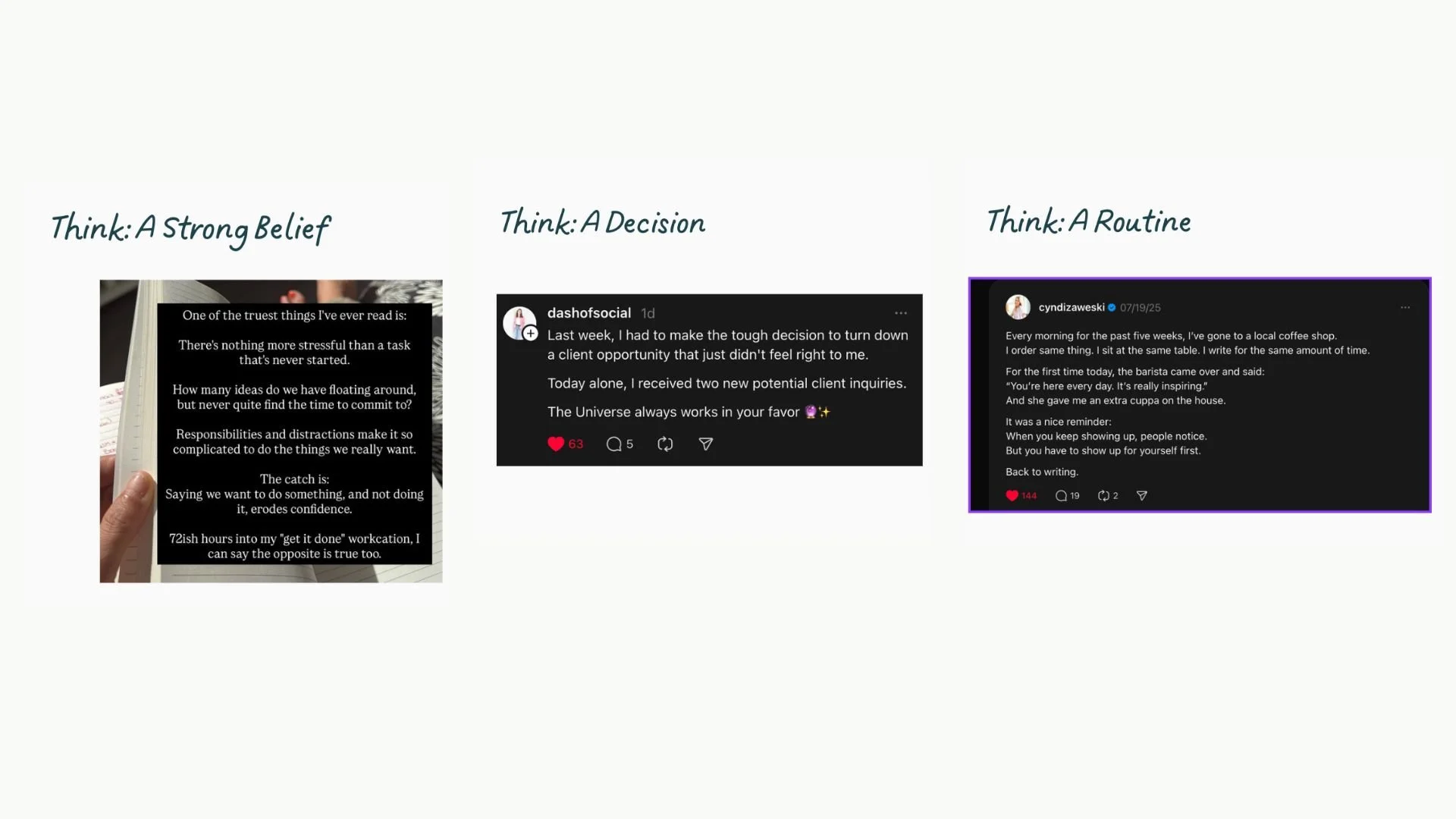
When you open with a character detail—a small window into your personality, belief, or decision—you create a curiosity gap.
Readers want to understand how your thinking shapes what happens next.
As they work to close that gap, they’re not just following your story.
They’re comparing it to their own.
That’s where connection between your story/marketing message and their real life happens.
In marketing, the “character” of a story is usually one of three people:
You – the voice behind the brand.
Your customer – the person whose story illustrates your impact.
A third party – someone who represents your bigger message (like referencing Steve Jobs to talk about innovation).
The key to character stories that work in marketing is what I call the gumbo shrimp rule—specific yet universal.
For example:
You might share a moment of making a tough business decision (specific), but your audience connects because they’ve all been in a moment of tough decision-making (universal).
That overlap—the specific detail with universal emotion—is what makes the reader the hero of your story, which makes them understand why your messages important to them.
Write Your Storytelling Hook
Think of one small detail that reveals who you are—
a belief, a quirk, or a choice you made that says something about how you see the world.
Use it as the opening line for a micro story.
Not sure how to write a micro story? Check out my free, no email required, step-by-step guide here.
