How To Tell Relatable Personal Brand Stories For Social Media
I’m a lot like my clients in many ways.
For one, it took me a while to share personal stories online.
I wanted to. But my list of excuses not to was pretty convincing.
I am a journalist by trade. I’ve spent a whole career being objective.
“Never insert yourself in the story!”
I recall an editor yelling into the newsroom at no one in particular when I was a new reporter.
Also—no one could possibly care about my experience beyond helping them, right?
I told a coach that once, and she looked at me like I had five heads.
“No, Cyndi. No one with an internet connection wants to hear more about you than the people that follow you,” she said.
Corrected. But still unmoved… “Aren’t my personal stories kinda boring?”
Coach— ::Eye Roll::
I’m going to give you the advice that I wish I got instead in this week’s newsletter.
Because here’s the thing—both my editor and my coach were correct.
Stories that are about “you, you, you” are just as boring as stories with no personal touch at all.
It’s nuanced. And that’s why it’s easier for most people to fall into one camp or the other.
But running a flag up the pole at either one, won’t make you a good storyteller.
In your marketing, or otherwise.
Finding emotional common ground is the key to successful personal brand storytelling that resonates. Let’s dive in.
Why Relatability Matters in Personal Brand Storytelling
Whether you’re a balloon artist or a small business accountant, if you are the face of your brand (i.e. you are the person answering customer inquiries or showing up on Reels) people need to know who you are—not just that you are good at what you do.
Expertise is the bare minimum if your goal is to build a community and clientele that keeps you in business without 24/7 hustle.
There’s no replacement for being a trusted name that people seek out.
We often hear that reliability is a key element of engaging marketing. Sometimes it gets pitted against authority.
Clients will often ask:
“Should I be more authentic or authoritative in my writing?”
To which I say, “Why choose?”
People trust people who are like them.
The familiarity signals safety, so we warm up faster.
When we hear a relatable story we:
Listen more (they’ll be open to your suggestions and solutions without needed to be persuasive)
Seek your opinion out (they’ll stop scrolling when they see your name).
Become a fan (sharing posts or recommending you).
This is why we do the work to find emotional common ground to tell relatable stories.
Should You Try To Be Relatable?
In middle school, I desperately wanted to fit in.
I begged my mom to get me the under-the-armpit-sized Louis Vuitton bag that would show those cool kids I was just like them.
Hundreds of dollars later, I was no cooler. But I was nursing the equivalent to rug burn under my arm.
Trying too hard to be relatable has the opposite effect.
Still—people try to do it all the time in their content.
Most people try to make their story relatable by flattening it—removing personal details, overgeneralizing, or inserting clichés they think “everyone” will understand. The result is a very vague story that lacks emotional depth. This can show up like:
Saying: "I was stressed out about an email I had to send."
Instead of: "I stared at the email for 20 minutes, knowing I had to respond but dreading every possible reply."
The reliability is in the specificity.
Not in the situation itself but in the emotion the situation creates. In other words—
It’s not the Louis Vuitton bag. Or the email.
It’s being an awkward middle schooler. And the anticipatory stress of waiting for a response makes people think, “I’ve been there!”
Tapping into emotional commonalities is the trick here. And it’s easier than it sounds (Storytelling prompts below).
Not coincidentally, it’s also how to avoid the “too much detail” storytelling trap we talked about last week.
Personal Brand Storytelling Example: Universal Story Themes
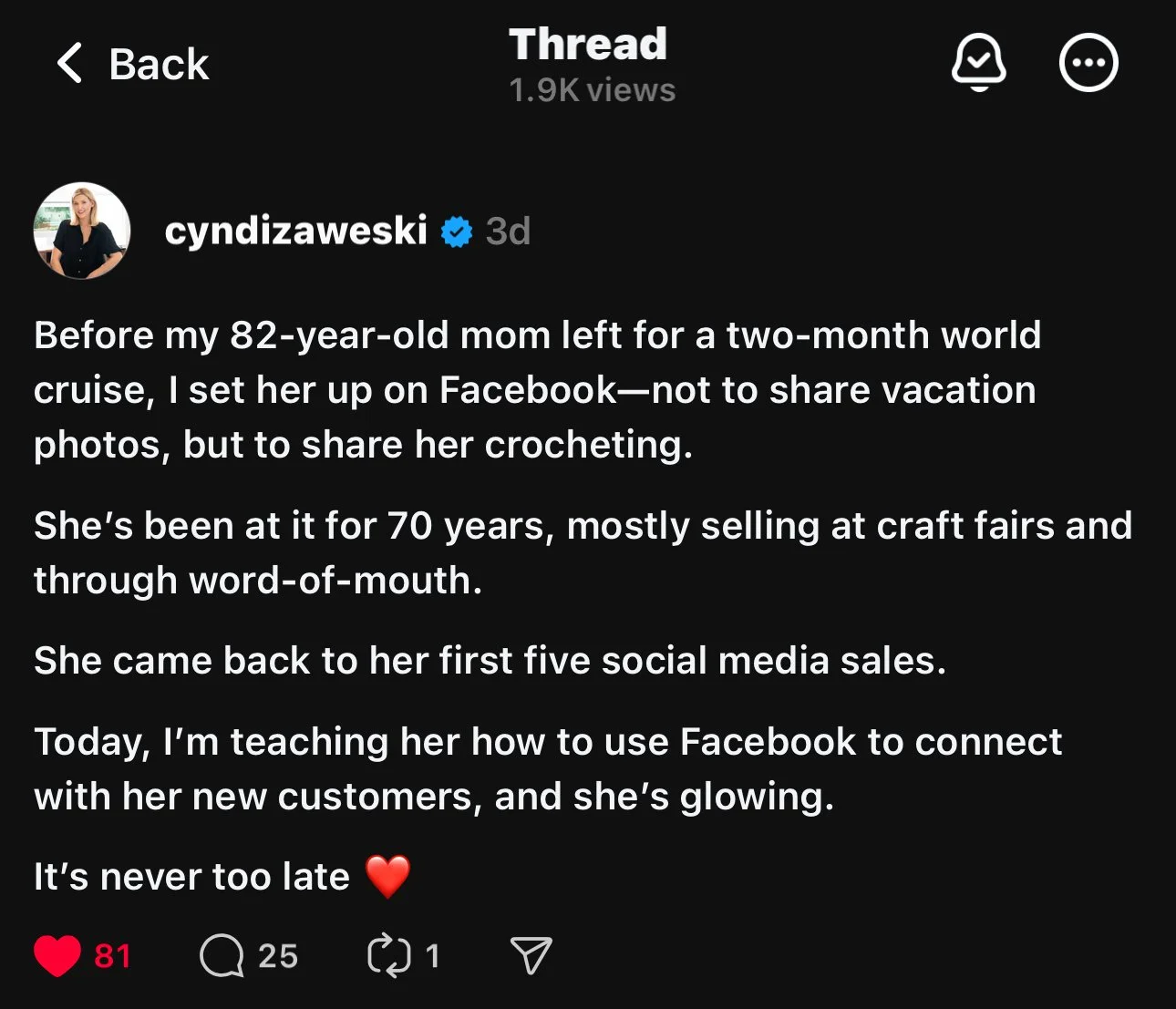
Over the weekend, I shared a personal story about my 82-year-old mom who just got back from a two-month world cruise.
At first glance, it might seem un-relatable to most people.
But it performed well—because it tapped into a universal theme: It’s never too late to start.
Universal themes are like the threads that pull the whole story together.
Common ones you can tap into are:
•Transformation – Who you were vs. who you became.
•Sacrifice – Choosing a harder path for a bigger purpose.
•Belonging – Finding your people, your purpose, or your home.
•Reinvention – A fresh start, a second chance, rising after failure.
•Underdog Triumph – Beating the odds, proving doubters wrong.
•Missed Warnings – Seeing the red flags but walking into the storm.
Keep these common story themes in the back of your mind as you answer this week’s storytelling prompts:
StoryCraft Storytelling Prompts:
How to Tell Stories That Resonate— Even When Your Experience Seems Un-relatable
1. Identify an emotion your audience feels.
Reflect something your audience is already experiencing or grappling with.
Are they hesitant to start something new?
Feeling stuck in a fixed identity?
Struggling with self-doubt?
2. Find the universal theme that ties to that emotion.
This is what makes a story resonate beyond your specific experience. Some examples:
Fear of starting something new → It’s never too late to try something new.
Feeling behind → There’s no one to compare yourself to when you’re on your own path.
Self-doubt → Small steps breed confidence.
3. Mine your life for a story that reflects that theme.
It doesn’t have to be the most dramatic or impressive story—it just needs to embody the feeling.
Like in my “ mom story.” It wasn’t about my mom; it was about trying something new later in life. That’s what resonated.
4. Tie it back to them.
The experience you pick should be illustrating the point you want them to take away from the story.
Got an idea? Swipe my simple storytelling framework to structure it for engaging threads, carousels, newsletters in my Storytelling Course.
Student Mark put it best:
“Since taking the course, I’m more confident structuring my messages in a way that actually engages people. My audience responds better, and I don’t overthink what to share anymore.”
Moral of the Story: We Know How You Feel
People don’t relate to what happened. They relate to how it felt.
The stress of waiting.
The sting of feeling left out.
The moment you realize you’re capable of more.
We all have stories like this.
Use this week's storytelling prompts to make people feel seen in your experience.
Thanks for reading, and as always…
Happy Storytelling,
Cyndi