
How To Tell Micro Stories To Grow Your Brand (with Examples)
Updated April 2026

Micro storytelling examples from my Instagram.
What Is A Micro Story?
What if you didn’t need to give all your best tips and tricks away for free to create engaging content that grows a community.
What if instead, people sought you out for your voice, your approach, and your message.
If you’re thinking that’d sure beat spending three hours in Canva on another 10-slide how-to for Instagram, micro storytelling might be more of your content creation style.
A micro story is a small, real-life moment you share that helps people understand what you believe and how you see the world.
They usually have a specific message, lesson, or insight gained from the experience
But micro stories don’t always have to be about you. For example, I use this micro story about Steve Jobs to share my brand message (see how I used in for a viral carousel post below).
However, micro stories that build a brand narrative do have to open a window into how you think, your values, and your approach to build the know, like, trust factor that makes connection possible and sales easier.
Today, we’ll talk about how to find those moments from your everyday life.
These micro narratives, often pulled from your ordinary, day-to-day life—the moments that might not feel like a big deal to you — are how your audience connects to you, your message, and what you stand for. Micro stories make people feel something in a limited character count. They’re short, like two to 10 sentences short, making them perfect for Instagram Carousels, storytelling captions, and newsletters.
In this article, we’re covering:
What Is A Micro Story?
The Benefits Of Trading ‘Tips & Tricks’ For Micro storytelling
Real-Life Micro Story Examples That Got Sales And Engagement
How To Use Micro Storytelling Create a Cohesive Brand Narrative
How To Write Micro Stories In 15 Minutes Or Less (Even If You’re New To Storytelling Marketing)
The best part? You don’t have to go looking for better stories… you just have to start paying attention to the ones already happening.
And once you start noticing these moments, you can’t unsee them.
They’re everywhere—in your routines, your conversations, your thoughts.
So if you’ve ever felt like you don’t have anything to say—or that your story isn’t “big enough”—this might change the way you see everything.
Let’s talk about how to find them, and use them to create content that’s more story than marketing.
The Benefits Of Trading ‘Tips & Tricks’ For Micro storytelling
Have you ever felt disconnected from your own content?
Like showing up online started to feel more like a chore than something you actually wanted to do?
That was me in the summer of 2023.
On paper, everything looked like it was working.
I had 60,000 engaged followers on Instagram.
But behind the scenes, it felt like I was stuck on a content hamster wheel—posting, optimizing, repeating—until it all started to feel more robotic than human.
I remember feeling almost embarrassed to admit it.
Like if I said it out loud, it would sound ungrateful… or worse, lazy.
So when I finally told my mentor, I braced myself for that.
Instead, he said three words that stopped me in my tracks:
“Don’t post value.”
I literally thought… what?
Because everything we’re taught says the opposite.
That every post needs to teach something.
Add value.
Be useful.
But at that point, I would’ve tried anything to feel connected to my work again.
So I decided to run a little experiment.
I already had a daily habit of jotting down story-worthy moments—small things from my day, little realizations, moments that felt like they meant something, even if I didn’t fully understand why yet.
Usually, I’d come back to those later and turn them into something more structured—carousels, captions, newsletters.
But this time, I did something different.
I challenged myself to take one of those moments and turn it into a complete micro story… and post it that same day.
Just a short story—2 to 10 sentences.
And I challenged myself to write them in less 15 minutes, riffing on my Seven Sentence Storytelling framework for structure.
That was it.
And after 30 days, something surprising happened.
People who had quietly followed me for years started replying.
Not to ask for tips.
Not for strategies.
Just to connect.
We talked about things like being dog moms, friendship, community… and storytelling itself.
Several of these former lurkers ended up joining my cohort.
But more than that, something shifted for me.
Those “value-less” stories brought me back to my creativity.
They helped me put words to thoughts so insightful, I didn’t even realize I knew.
That’s the power of a micro story.
Micro Story Examples
Micro stories don’t come from big moments.
They come from things you almost overlook:
Something a client said to you
A counterintuitive truth
A realization you had while working on a project
A small moment from your day that illustrates to your message
Micro storytelling example: “I somehow overcooked and undercooked pasta at the same time, and it reminds me why good things require your full attention.”
A past experience that shaped how you approach your work
Something your heard on a podcast, read in a book, saw on your favorite HGTV show.
Let me show you what this can look like.
This is one of my favorite examples of a micro story because it starts with such an ordinary “boring” moment.
But that’s the beauty of micro stories. They don’t need to be big to be meaningful.

Here’s An Example Of A Micro Storytelling That Peppers In Perspective
What I love about this example is that it’s not really about dinner.
It’s about the shift from perfection to connection.
I used to think making people feel welcome meant making everything look just right, and that made hosting feel more stressful than joyful.
But when I let go of that, we actually got closer.
We had more fun.
And the night felt more like what I wanted it to feel like in the first place.
Connection over perfection is a core philosophy of mine.
And when I shared this, people who had been quietly following me for years started responding—not because it was groundbreaking, but because it reflected something they believed too.
They just needed me to share it first.

Here’s Micro Story Example That Shares A Brand Message
I recently shared a viral carousel with the IG cover slide headline: “Steve Jobs Sucked At Storytelling.”
I discovered this nugget about Jobs when I was reading a book. Things you hear on a podcast, read in a book, or spot while scrolling make for great micro story inspiration—as long as you put your twist on the idea.
Here I used a riff on my Seven Sentence Storytelling framework to write a micro story that shared my brand message. It starts with a counterintuitive truth captured in a hold headline that hits like a cognitive speed bump.
It forces the reader to physically slow down and reconsider what they thought they knew. Because the world has canonized Jobs as the ultimate communicator, a headline like that blows expectations out of the water. It creates a gravitational force of uncertainty, pulling people in because they have to know how that could possibly be true.
This storytelling Carousel goes on to solidify my brand message by sharing a micro narrative about Jobs’ journey from terrible storyteller to earning storytelling God status.
Did you know that before Job’s legendary "1,000 songs in your pocket" era, there was the LISA era— with a nine-page, jargon-filled New York Times ad that flopped so hard it essentially got him fired from his own company?
By showing that even the "God of Storytelling" had to fail his way into the history books, I shared my brand message: You don’t have to be a natural born storyteller to tell great stories. And I gave my readers the warmest feeling of all: Hope. I met them in their frustration ("I’m just not a natural storyteller") and led them to empowerment ("I can learn this, too").
You can read the full “Steve Jobs Sucked at Storytelling” Carousel here. You’ll see how I broke down the narrative into bite size chunks with one-to-two sentences on each slide.
If you want to try it for yourself, download my Seven Sentence Storytelling Framework for free here.
How To Write A Micro Story
Writing a good micro story is really about finding meaning in ordinary moments.
It asks you to slow down. To notice what’s usually rushed past, overlooked, or dismissed as too small to matter.
The Three “S” Rules of Micro Storytelling
To keep these narratives short and effective, a micro story usually follows three rules:
Specific: It happens in a specific place at a specific time (e.g., "Yesterday at the grocery store," not "Usually when I shop").
Short: It’s 2 to 10 sentences. If you find yourself adding "background info," you're probably writing a regular story. Cut it back.
Shift: Something changes. You go from tense to relaxed. From self-conscious to seen. From frustration to perspective.
Once you understand this, you stop searching for something better to say.
You start seeing how much you already have.
And if you want a few more examples like this—plus a simple way to turn your everyday moments into micro stories—I put together a free guide you can use to get started.
It comes with my student-favorite Seven Sentence Storytelling Framework, a step-by-step template to tell your story concisely.
You can grab it here →

How To Use Micro Stories To Create A Cohesive Brand Narrative
It’s a myth that brand narrative is a single story that shares everything about you and your work.
It’s not a summary.
It’s not one origin story.
It’s not something you sit down and “figure out” once and for all.
A brand narrative is the story people tell themselves about your brand, including what you value, your vision, and a general sense who you are, and how your mission helps them.
It’s built over time—through the small moments you choose to share.
On their own, each of these micro stories might feel small. Maybe even too small to matter.
But they don’t work in isolation.
Every micro story is like a breadcrumb in a larger brand narrative strategy. Let me paint you a picture of how this works in real life.
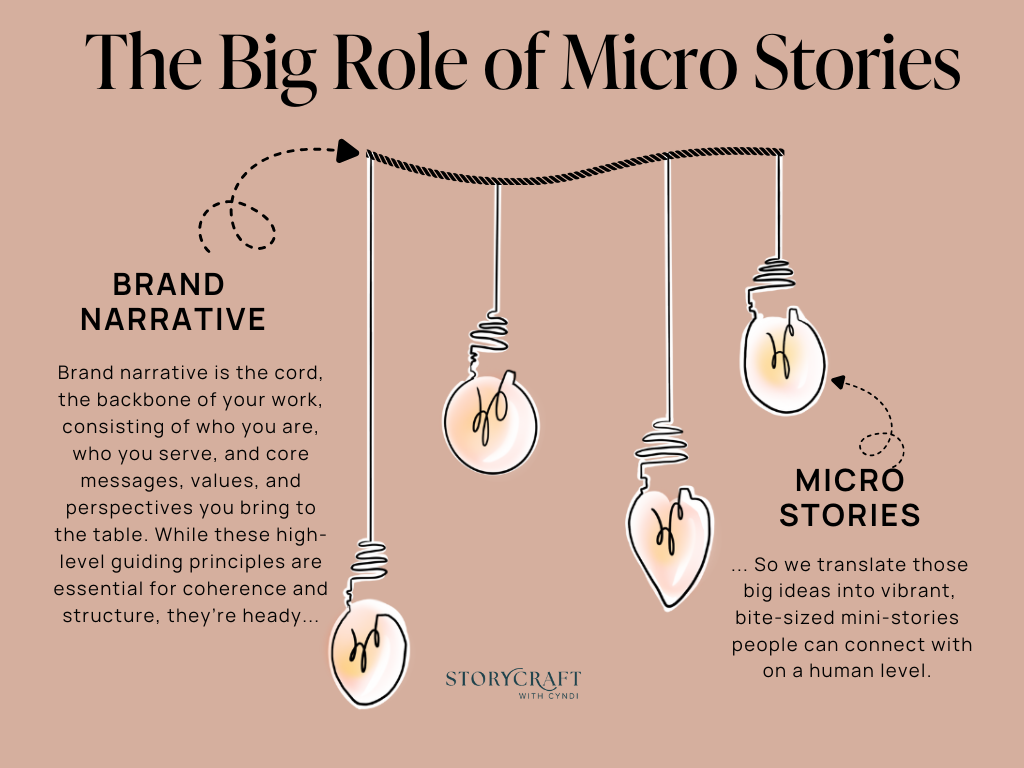
Micro stories, ground big, heady concepts into tangible nuggets people can quickly understand, process, and connect with.
Let’s face it, telling people “my point of view is rooted in authenticity” or “my core message is do less and attract more” doesn’t have the same magnetism as telling a story that demonstrates it.
You can think of your brand narrative like the cord and your individual micro stories like the lights. Brand narrative is a thread that ties all of your individual content together for cohesiveness.
When micro stories consistently point back to the same perspective, they build a recognizable brand narrative.
Over time, these short stories help your audience understand:
How you think
What you value
What you believe
And why your approach is different
That repetition is what turns individual posts into a cohesive body of work that reinforces your message and makes you known for how you help—without you having to spend hours creating “tips and tricks” content that’s forgotten as quickly as it’s posted.
Thanks For Reading!

Cyndi Zaweski, Owner of StoryCraft
Cyndi Zaweski is an independent journalist and the owner of StoryCraft. She writes primarily about how narrative influences behavior, exploring how storytelling, belief, and perspective drive action through the lenses of marketing, philosophy, psychology, technology, spirituality, and beyond. Her brand story clients have been featured on CBC, iHeartRadio, The Minimalist Podcast, and more.
FAQs About Micro Stories
-
A micro story is a small, real-life moment you share that helps people understand what you believe and how you see the world. These micro narratives, pulled from your ordinary, day-to-day life—the moments that might not feel like a big deal to you — are how your audience connects to you, your message, and what you stand for. Micro stories make people feel something in a limited character count. They’re typically two to 10 sentences, making them perfect for social media, podcasts, and newsletters.
-
Most micro stories are between 2 to 10 sentences. The goal is to keep it focused on one moment and one shift, without adding extra context that doesn’t serve the point. They can be less than 100 words but usually no more than 500 words.
-
Instagram captions, IG Stories, Threads, LinkedIn posts, newsletters, or short-form video.
-
Aside from helping you become a better storyteller and develop your creative voice, micro storytelling builds trust and emotional connection with your audience.
They also make your message more memorable, helping you stay top of mind in an age of information overload.
-
To keep these narratives short and effective, a micro story usually follows three rules:
Specific: It happens in a specific place at a specific time (e.g., "Yesterday at the grocery store," not "Usually when I shop").
Short: It’s 2 to 10 sentences. If you find yourself adding "background info," you're probably writing a regular story. Cut it back.
Shift: Something changes. You go from tense to relaxed. From self-conscious to seen. From frustration to perspective.
-
They don’t replace it—they deepen it. Micro stories help people connect with your ideas, so when you do share insights or frameworks, they feel more relevant and easier to trust.
-
Traditional storytelling is a full narrative with context, developed characters, and multiple scenes. Micro storytelling focuses on one small, specific moment that illustrates an insight or perspective.
-
It helps people understand who you are—not just what you do. Micro stories create emotional context around your work, which builds trust and makes your message more memorable. When used consistently, they form a clear narrative about your expertise and values. That’s what makes people feel connected enough to follow, refer, or buy.
-
Advice tells people what to do; micro stories show how you learned it. The story format adds credibility because it demonstrates lived experience. It also invites the audience to draw their own conclusions, which creates more engagement and trust. A story can contain insight, but it’s delivered through context—not instruction.
