
Show Don’t Tell: 3 Ways To Use Observation In Emotional Storytelling
Updated: April 2026
Summary: “Show don't tell" is common storytelling advice—yet it's hardly practical on its own. Here are three way actionable ways to use observation to write emotional storytelling content that shows not tells.

Write A Show Don’t Tell Story With Observation
I was at a story slam when someone got up on stage and started talking about getting dumped over a stack of pancakes.
I'd be lying if I said the story was off to an interesting start.
But the way she described the syrup trailing off the side of his fork—like it couldn't wait to escape either—was the detail that made the whole room hang on every word.
That use of ‘show don’t tell’ was the defining line that saved her story was the result of pure observation.
Noticing and incorporating sensory details into your storytelling engages readers by drawing on all five sense: sight, sound, smell, taste, and touch.
Senses translate into emotions because physical feelings—like a racing heart or a familiar scent—trigger an instinctive reaction in the reader's own body.
Instead of just telling them what happened, you’re giving them the physical ingredients to feel the emotion for themselves.
That's what makes people invested in your story.
Below are three very short practices to hone this essential emotional storytelling technique, plus show don’t tell story examples so you can weave these narrative techniques into your storytelling content creation.
How To Use The Show Don’t Tell Story Technique In Personal Narratives
Show don’t tell is a storytelling essential because it gives readers the physical cue they need to experience a feeling firsthand.
When you describe a sensation instead of naming an emotion, you let the reader's brain draw its own conclusion, which makes the experience your writing about play like movie in their mind.
Observation is the best skill a storyteller can develop because of this reason. Observation helps you put words to specific, real-life details that make a scene feel authentic rather than generic.
When you notice exactly how a door creaks or how cold air stings the lungs, you can give your reader the precise cues they need to believe in the moment.
Keen observations are a wellspring of original content.
Finding the meaning in what you notice can serve as inspiration for story ideas, and can be used as story hooks or to make an brand message more emotionally engaging.
How do you do ‘show don’t tell’ writing?
Here’s an example:
When you tell, you share facts like: "My client 3x her revenue."
But when you show, you draw people in: "After years of struggling to make ends meet, she finally booked that long-overdue family vacation to Paris—her kids couldn’t believe it was happening."
Show don’t tell moves your audience from passive reader to engaged in the experience.
Here’s are three ways to write show don’t tell stories for your content.

Show Don’t Tell Example: Use Dialogue Bring People Into The Moment
Instead Of: "The results were better than expected."
Swap For:"'Wait... is this right?’ I thought refreshing my inbox. Four orders in a day was more than I could dream two weeks ago."
2. Show Don’t Tell Example: Use Comparisons To Turn Abstract Feelings into Vivid Imagery
Instead Of: "My client was overwhelmed before she met me." Swap For: "Donna’s to-do list was like an avalanche—no matter how fast she shoveled, more just kept piling up."
3. Show Don’t Tell Example: Describe Actions
Instead Of: “I was stressed and trying to stay awake to finish the project." Swap For:"I snapped my hair tie on my wrist, hoping the sting would keep me alert as I stared blankly at the screen, waiting for the words to come."
Emotional storytelling is a dance between what you say and what you leave unsaid. When you show, you give your audience the chance to fill in the details, to visualize, to feel.
3 Show Don’t Tell Exercises To Turn Observations Into Emotional Storytelling
There are emotionally gripping details in everyday moments—like the syrup plotting its escape.
All it takes is a little slowing down to catch them red handed.
When you stop rushing, you give your brain the time to register specific textures, rhythms, and shifts in the environment that bridge the gap between a generic moment and a visceral, emotional experience.
It takes intentional practice to train your mind to spot the details after a lifetime of living our fast-paced world.
Here are three observation exercises to capture the sensory details needed for emotional storytelling content.
1. Two-Sentence Scene Capture
At the end of the day, write one sentence that captures something you saw that day—as specifically and concretely as possible.
“The barista had two bandaids on the same knuckle and still smiled like she wasn’t bleeding.”
Why it works: You train yourself to look for the unexpected in the everyday.
Then, note your feelings or insight in one line.
“It reminds me how I ignore my needs and push through to make others comfortable.”
Meaning making is your superpower as a storyteller.
When you can use observations to illustrate a bigger emotional truth, you’ve got the makings of a compelling story.
2. Describe Without Naming
Pick an object—or a person you see on the train, in line, wherever—and write a few lines describing it without naming it.
Not “a leather bag,” but:
“The cracked handle where someone kept grabbing it in a rush. The tiny scuff that looked like a burn mark. The color that had once been black but now read more like asphalt after a long summer.”
Why it works:
This exercise retrains your brain to see, not summarize. Most people stop at the label—but labels don’t tell stories. Descriptions do. When you describe something in detail, you add texture and specificity—and that’s what makes scenes vivid and characters feel real. If your stories feel flat, chances are you’re naming instead of noticing.
3. Soundtrack Your Surroundings
Sit somewhere for 3 minutes. Close your eyes. Write down every sound you hear. Then pick one and give it a backstory.
That high-pitched squeak? Maybe it's the ghost of a bored janitor’s sneaker haunting the hallway.
Why it works: Sensory detail is one of the fastest ways to immerse your reader—but most people only write what they can see. This exercise helps you slow down and tune into the full environment. It teaches you to layer a scene with sound, rhythm, and vibe. I learned this in a memoir writing class recently, and I was blown away by how much more dimensional the stories became—just from noticing what the room sounded like.
Practice Creates Creative Instinct
Catching the meaningful details in every day life becomes second nature in time.
When you first start intentionally practicing observation, it feels like manual labor because you’re forcing your brain to switch off its autopilot mode.
However, with practice, you develop a sort of sensory muscle memory where you no longer have to hunt for those unique details—they start jumping out at you.
Eventually, you won’t have to try so hard to bridge the gap because your brain will begin to automatically making mental notices, turning a conscious effort into a creative instinct.
Turn Observations Into Micro Stories
The glint on a glass during a fight. The way a child tugs their sleeve when they lie. These moments anchor your story in a familiar reality.
Use these practices to tell emotion personal brand stories that linger in people’s minds long after you hit publish.
Now it’s time to turn these tips into storytelling content.
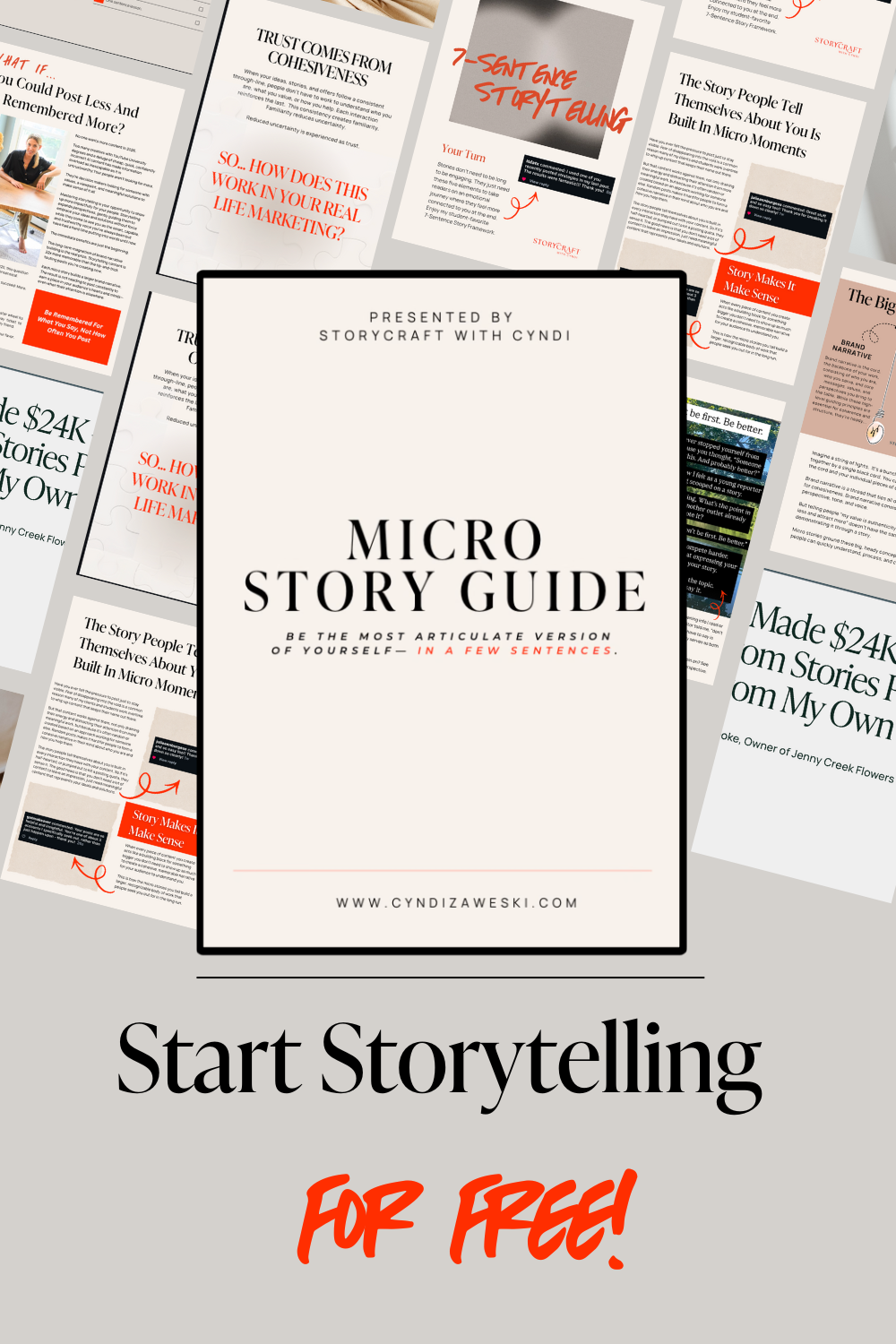
I put together this free Micro-Storytelling Guide so you can implement these emotional storytelling ideas in your short-form content.
In as little as 15 minutes you can go from “I sorta have a story idea” to hitting publish on an emotionally-relevant post makes your brand message memorable and trustworthy.
In this free guide, you’ll get:
The three types of emotionally-relevant micro stories
My viral 7-Sentence Storytelling Framework For Social Media
How to tell stories that feel like you — and take only a few minutes to write
Cherry On Top: you can log off with the peace of mind that you won’t be forgotten, because storytelling is 22x more memorable than regular posting.
Thanks For Reading!

Cyndi Zaweski, Owner of StoryCraft
Cyndi Zaweski is an independent journalist and the owner of StoryCraft. She writes primarily about how narrative influences behavior, exploring how storytelling, belief, and perspective drive action through the lenses of marketing, philosophy, psychology, technology, spirituality, and beyond. Her brand story clients have been featured on CBC, iHeartRadio, The Minimalist Podcast, and more.
