
Steve Jobs is credited with saying the most powerful person in the world is the storyteller.
Today, we’ll see the economy of that power.
As SpaceX prepares for the largest-ever stock market debut at $1.75 trillion between 11:30 a.m. and 2 p.m. EST today, storytelling is, in no small part, why. A narrative good enough for the wealthiest and most powerful people on Earth to buy in—and, in doing so, drew everyone else in too, directly or indirectly, consciously or unconsciously.
As we're confronted with the prospect of one man overseeing trillions of dollars in the world's financial assets, we're also confronting the narrative that put him there—and our place in it.
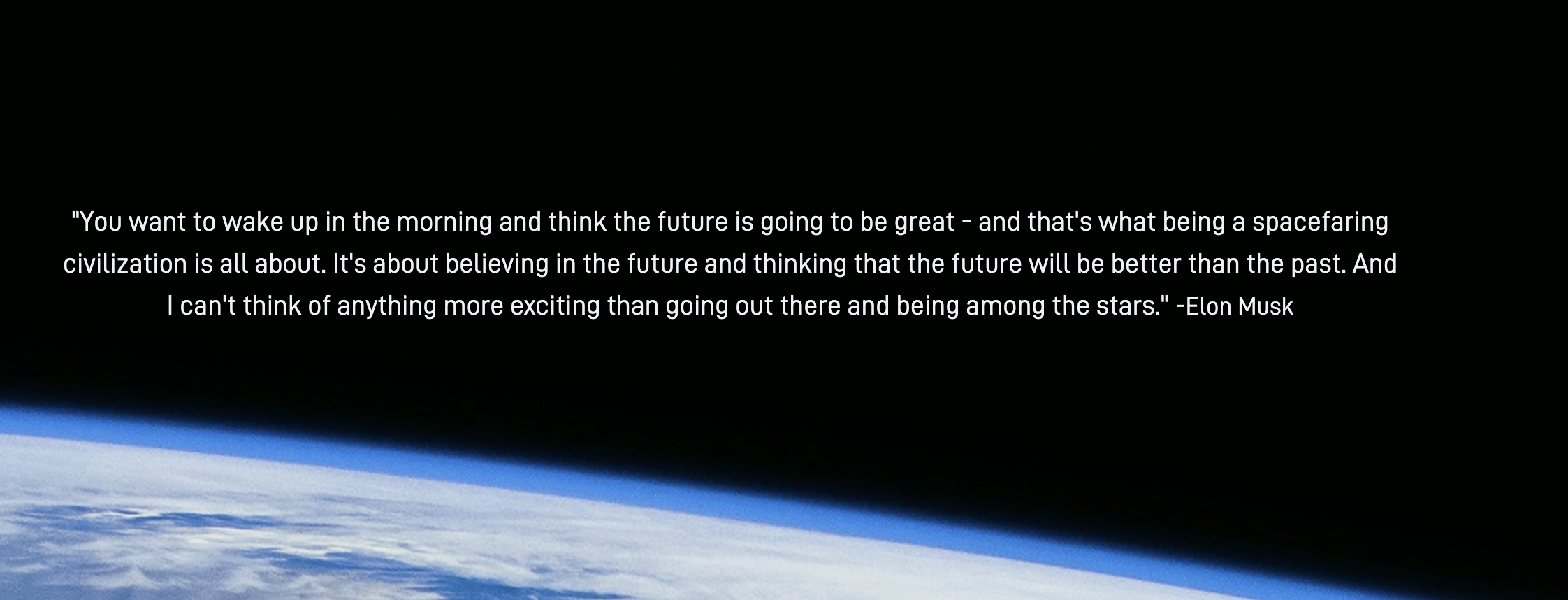
To understand the origins of the story, we need look no further than SpaceX’s website.
"You want to wake up in the morning and think the future is going to be great - and that's what being a spacefaring civilization is all about. It's about believing in the future and thinking that the future will be better than the past. And I can't think of anything more exciting than going out there and being among the stars." -Elon Musk
Like many great stories, this one begins with a desire.
When eBay bought PayPal in 2002, Musk walked away with a payout of roughly $175 million—and a problem.
What would he do with the money?
Driven by a lifelong interest in space exploration, Musk decided his new mission in life was to reignite public interest in space travel.
So he tried to buy a rocket. First, from the American government. Even a fixer-upper was beyond Musk's then purchasing power. So he asked the Russians.
They laughed at him.
No rocket for you!
Even $175 million richer, Musk could not afford a rocket.
It is at this moment SpaceX is born.
Musk realizes it's not lack of public interest that prevents us from exploring space.
It's the exorbitant cost of exploring space that prevents us from exploring space.
SpaceX now has a single mission: to make space travel cheap enough to be practical. And all of it hinges on the story Musk tells himself first—that space travel will make for a better tomorrow. That belief is what gets packaged into the mission statement above.
Then the machine begins to turn.
First, investors buy the story.
Their money makes results possible.
Governments buy the results.
And because of that, everyday people fund the mission that fuels Musk's fictional version of the future.
Of course, investors don't buy stories. They buy returns. It's true—no venture capitalist wired Musk money out of love for the cosmos alone. But ask: why would anyone believe the returns are coming at all, from a company that loses billions a year and won't turn a conventional profit for years?
The answer is the story. A believable future is what turns a far-off version of reality into a rational one. The narrative doesn't compete with the profit motive; it's the thing that makes the profit motive add up. Without a story worth believing, handing one man billions looks like a savvy way to get in early.
The numbers bear it out. Over its lifetime, SpaceX has secured between $20 billion and $22 billion in U.S. government contracts. The overwhelming majority flows in directly from the United States government, in federal contracts, grants, and subsidies. But the well runs wider than that: through commercial deals, sovereign wealth funds, and middlemen, countries like Australia, Saudi Arabia, the United Kingdom, and South Korea pour in resources of their own.
Whatever you make of Musk the man—there are many feelings—SpaceX is a genuine marvel of human ingenuity. Its signal achievement, learning to routinely land and reuse orbital-class rocket boosters, has remade the global space industry by collapsing the cost of reaching orbit.
Russia is eating cold crow. Investing billions in SpaceX, far from laughable, is now the smart move in the eyes of the richest and most powerful people alive.
In 2002, Musk's own money couldn't buy a rocket.
So he told a story good enough for other people's money to buy it instead.
Today, we'll see how fiction makes for history-breaking sums of cash. SpaceX took in $18.7 billion in revenue last year and lost nearly $5 billion; at the numbers being floated, as The New York Times reported on May 20, the debut would value the company at somewhere between 60 and 100 times its sales—a price that measures not what it earns, but the fairytale of what it could become.
But the fairytale outcomes don’t always come to pass for Musk—or the people who invest in them.
Remember his purchase of Twitter for $44 billion in 2022? The company, now known as X, saw its ad revenue decline by 65 percent last year. Musk folded it into his A.I. company, xAI. Which is now part of SpaceX, The New York Times’ Sam Siffon reminded us this morning.
If it goes through, SpaceX will instantly rank among the ten most valuable public companies on Earth. And once it's public, millions of people could find themselves indirectly invested in it through retirement funds, index funds, and ETFs—whether they approved it or not. (You can read more about how the SpaceX IPO will impact retirement accounts here.)
Its launch capability, its satellite network, its government contracts: all of it now load-bearing infrastructure. And Musk will keep roughly 85 percent of the voting power through super-voting shares—enough that he could be removed only by voting to remove himself. The offering further entangles the company's fortunes with the long-term health and stability of the global financial system.
No matter where you live, resources are being pooled into one man's vision of the future.
But what if you don't believe that being among the stars is what makes for a better tomorrow?
For those of us who can imagine a more exciting future than being among the stars, a better future here on Earth, it’s up to us to tell better stories—and let them guide our mission.

Cyndi Zaweski, Owner of StoryCraft
Cyndi Zaweski is an independent journalist and the owner of StoryCraft. She writes primarily about how narrative influences behavior, exploring how storytelling, belief, and perspective drive action through the lenses of marketing, philosophy, psychology, technology, spirituality, and beyond. Her brand story clients have been featured on CBC, iHeartRadio, The Minimalist Podcast, and more.
