
Emotional Storytelling Cheat Sheet: A Business Owner’s Guide To Writing Empathetic Stories For Short-Form Content And Sales
Updated: April 2026
Emotional Storytelling for Short-Form Content Creation And Sales
Emotional storytelling is the great communicator.
Maybe you've felt the frustration of repeating yourself to an audience that isn't listening.
Maybe you've given away so much free value into your content, only to be met with silence.
Or maybe you're so deeply immersed in the nuance of your craft you've lost the ability to explain it simply.
Then emotional storytelling is the skill that will flip the switch.
Emotional storytelling is the act of sharing a narrative that focuses on human feelings and experiences to make a specific point.
In a business context, it means moving away from listing facts, data, or features. Instead, you describe a situation where a person faces a challenge, feels an emotion, and reaches a resolution.
It’s the difference between looking at a photo of the Grand Canyon and watching the gravel fall as your feet inch closer to the edge.
Storytelling marketing is celebrated because it “speaks to people’s emotions.”
But which emotions? And how do you evoke those emotions without being manipulative?
This emotional storytelling cheat sheet for identifying and describing feelings for short-form content creation.
Below you’ll find emotional storytelling examples, an emotional storytelling framework, and story hooks you can use for sales, or form a deeper connection with your audience. Let’s dive in.
Why Is Emotional Storytelling Good For Business?
Emotional storytelling is good for business because it makes people understand why they should care.
Facts and figures might provide the "what," but selling emotions provides the "why."
Before we dive into the cheat sheet, let me show you the difference in this emotional storytelling example:
Let’s say you sell coffee, software, or consulting, there are likely ten other people selling something similar at a similar price.
That’s a commodity.
If you compete as a commodity, it’s a race to the bottom. The lowest price for a similar product will win.
But if you’re product is more than a commodity, then your pricing options expand beyond what the market dictates.
Here’s what this looks like in real-life:
The Logic: "This coffee is $4 and tastes like Arabica beans."
The Emotional Story: "This coffee supports a family-owned farm where we’ve worked for three generations to preserve the local ecosystem."
The Result: Customers aren't just buying a product; they are buying into a mission.
Storytelling turns a commodity into a category of one. Talk about brand differentiation!

Ultimately, the reason emotional storytelling works is because it’s how humans are wired to communicate. Just think about your own experience.
When your hear a dry lecture, your hand is reaching for your phone without a second thought.
But when you hear a story that interests you, all of a sudden your phone has lost all of its appeal.
You’re there in the moment with the storyteller.
That happens because when we hear a compelling story, our brains behave as if we are living the experience.
Oxytocin, the bonding hormone, is released, building trust between the storyteller and the audience as they share a narrative journey.
Not only does emotional storytelling make you more trustworthy, it also makes your ideas more memorable—22 times more memorable than regular content alone.
Emotional storytelling is a Trojan Horse.
The brain relaxes because it thinks it’s just being entertained by a narrative. While the "gates" are down, the complex, nuanced, or otherwise “boring” message (the soldiers inside the horse) is smuggled into the listener’s understanding.
By the time the story is over, they’ve absorbed the concept without even realizing they were being taught.
If you’ve ever worried about feeling “preachy” in your short-form content, consider emotional storytelling the antidote.
Emotional Storytelling For Selling Without Selling
Brand differentiation, trustworthiness, and memorability, are just the tip of the iceberg when it comes to emotional storytelling for sales.
Especially, if you hate selling, and are turned off by traditional marketing tactics that push pain points that— frankly—feel straight up sleazy.
When I first started learning how to translate my journalistic storytelling skills into storytelling marketing, one piece of advice showed up everywhere: Call out pain points.
You know the style. Hooks like:
“You’re lazy because you don’t stick to your goals.”
“You can’t make sales because you’re afraid to ask.”
Those hooks may not be factually incorrect. And they do grab attention.
But they also put people on the defensive.
Consciously or subconsciously, accusatory language makes people feel attacked, making them less open to hearing your solution.
Storytelling for sales, on the other hand, allows people to put their guard down—so they’re open to your solutions.
Yet—we’re told the most effective way to get people to buy is to scare them into taking out their credit card.
Harping on pain points is why so many business owners I work with hate selling.
Building a business by telling customers what’s wrong with them just to make money is a betrayal of their values—and many end up on the brink of going out of business because they believe it’s the only way.
As a storytelling coach and narrative strategist who’s more than tripled her corporate income by sharing values-driven storytelling content, I can tell you fear tactics are not your only option to sell.
Empathy-based, ethical marketing is about naming, not blaming.
It’s giving language to the frustration, doubt, or disappointment your audience already feels—without making them feel less than for having a problem.
Naming builds trust through shared understanding (empathy), which makes sales a byproduct of confidence in your solutions rather than pressure to act out of fear.
This approach to emotional storytelling focuses on painting possibilities. Hope is one of the greatest feelings you can give to your audience.
Let’s talk about how to convey emotions in short-form content.
Next you’ll learn how to to use storytelling for sales in short-form content creation ethically.
Instead of traditional fear-based marketing tactics, you’ll learn how to identify the specific emotions your audience feels, so resonate with your message and trust your solutions.
Emotional Storytelling Framework
Do you ever notice when people are having feelings they tend to use a vague, catchall term to describe them?
If they’re overwhelmed, they might say, “I’m stressed.”
If they’re angry, they default to, “I’m pissed.”
If they’re sad, maybe it’s, “I’m drained.”
Researchers call this emotional “clumping”
It’s the tendency to reduce the complexity of our feelings into one general word.
But like a painter’s palette, there are many many shades to emotions.
It’s not just anger, it’s enraged or frustrated.
Precision isn’t semantics.
On a personal level, not being able to put words to specific emotions leaves you feeling stuck.
As a storyteller, not being able to put words to specific emotions makes your reader feel misunderstood.
Empathy is created through understanding. Understanding is generated through specificity.
The more precise you can be, the more emotionally relevant your message becomes—and the fewer words you need to express it clearly, which is ideal for short-form storytelling.
But in most marketing, you’ll see people mash emotions together like “stressed” and “overwhelmed.”
They’ll clump everything their audience is feeling together as a way to cover all the bases.
But your audience’s brain can only process so much at once, especially in short-form sales content.
When you throw two or three different emotions and meanings into one story, you're not being thorough—you’re creating confusion.
That’s why effective short-form storytelling follows this framework:
One story, one emotion, one promise
Choose the emotion.
Your audience can feel many things about the same situation—but for this story, focus on one. See the cheat sheet below for the most common emotions to start from.Illustrate it with one moment.
Once you’ve chosen the emotion, share one story from your own life that shows it. The situation doesn’t have to match your audience’s — it just needs to reflect the same emotion. If you’re an SEO pro whose audience feels frustrated that their SEO isn’t working, you don’t need a story you were frustrated about SEO. You could share a time you tried several solutions to a problem and nothing worked. The point isn’t to mirror their circumstances. It’s to name the emotion clearly so they feel understood.Offer one promise.
When you name an emotion precisely, you’re not just describing a feeling — you’re pointing to the problem behind it. If someone says they feel “anxious,” that usually means they’re stuck between too many choices and don’t know which way to go. The problem isn’t anxiety, it’s the lack of clarity. Once you describe the specific emotion, you can give them an aha moment by showing them the deeper issue. Once the problem is clear, you can give a clear action step — whether that’s offering a paid solution, reassurance, education, or a new perspective.
Let’s jump into the truly actional part of this emotional storytelling article. Learn how to identify your audience’s emotional needs so you can tell the right story.
Emotional Storytelling Cheat Sheet
This chart provides a quick-reference guide to ditch vague terms and identify the root of your audience's feelings.
By matching a specific emotional to a corresponding brand message or solution, you can create more precise, empathetic stories that lead naturally to your offers.
EMOTIONAL STORYTELLING IDEAS FOR BUSINESS OWNERS
| Emotion | Cause | What They Need to Hear | What Story To Tell |
|---|---|---|---|
| Frustration | Effort without results. Feeling stuck despite doing the work. | Show how your solution removes roadblocks and makes effort pay off. | Share a time you did everything "right" but didn't move until a breakthrough. |
| Disappointment | Unmet expectations. The gap between promised outcomes and reality. | Show how your solution resets expectations and delivers on promises. | Tell a story about the time you found a "solution" only to be let down. |
| Hope | Belief that change is possible through small wins or new progress. | Highlight new possibilities and perspectives your solution opens. | The moment you saw a way forward or a reframe that renewed your faith. |
| Anxiety | Triggered by too many unknowns and the fear of choosing wrong. | Narrow down the choices. Show why your path is the clear one. | Share a time you were stuck in analysis mode and how you finally took action. |
| Sadness | Believing all options are exhausted and it's the end of the road. | Educate them on possibilities they didn't know they had. | How you learned about new options and why they work for people in their shoes. |
Below you’ll find storytelling for sales ideas with these five common audience emotions.
Short-form Story Ideas For Emotional Storytelling For Sales

Frustration
Frustration comes from putting in effort and not seeing results. If your audience feels frustrated, it’s because they’ve done the work, followed the advice, and still feel stuck.
As a business owner: show how your solution removes the roadblocks and gets their effort to finally pay off.
As a storyteller: share a time you were doing everything “right” and still weren’t moving forward — and what finally broke the stalemate.

2. Disappointment
Disappointment comes from unmet expectations — when someone hoped for an outcome and didn’t get it.
These stories are about the gap between what they thought would happen and what actually did.
As a business owner: show them how your solution resets expectations and delivers what others overpromised.
As a storyteller: tell a story about the time you thought you’d found the answer, only to be let down — and what that experience taught you. Here’s an example of expectation versus reality in emotional storytelling.

3. Hope
Hope is the belief that change is possible.
It often comes from small wins, seeing progress, or realizing you’re not alone. If your audience is stuck, share a story of hope to encourage and empower them.
As a business owner: highlight the new possibilities your solution or perspective opens up.
As a storyteller: tell a story about the moment you saw a way forward or a reframe that renewed your faith.

4. Anxiety
Anxiety is the trigger of too many options, too many unknowns, and no clear next step. It’s the worry that choosing wrong means failing.
As a business owner: narrow down the choices and show why your path is clear and effective for someone in their shoes.
As a storyteller: share a time you felt stuck in analysis mode, and how you finally moved forward.

5. Sadness
Sadness is believing there are no options left.
It’s the feeling that this is the end of the road.
As a business owner: educate them on possibilities they didn’t know they had.
As a storyteller: tell them about how you learned about the options and why your way works best for people in their shoes.
Emotional Storytelling For Sales Starts With Empathy
You’re Not Special—And That’s Your Storytelling Superpower
The prevailing wisdom in marketing is to stand out.
But in storytelling, what makes people loyal isn’t how different you are — it’s how similar you are.
We’ve all known:
The pain of rejection.
The exhaustion of trying and failing and trying again.
The relief of finally figuring out something that works.
These moments are the experiential common ground required for empathic, emotionally storytelling.
When you describe emotional with precision, your audience feels understood.
Once they feel understood, they’re more open to your perspective and your solutions without needing traditional fear-based tactics to get a response.
How To Write Short-Form Content With Emotional Storytelling
Identifying the emotion is the first step, but sitting down to write it can have you second-guessing what to say and how to say it.
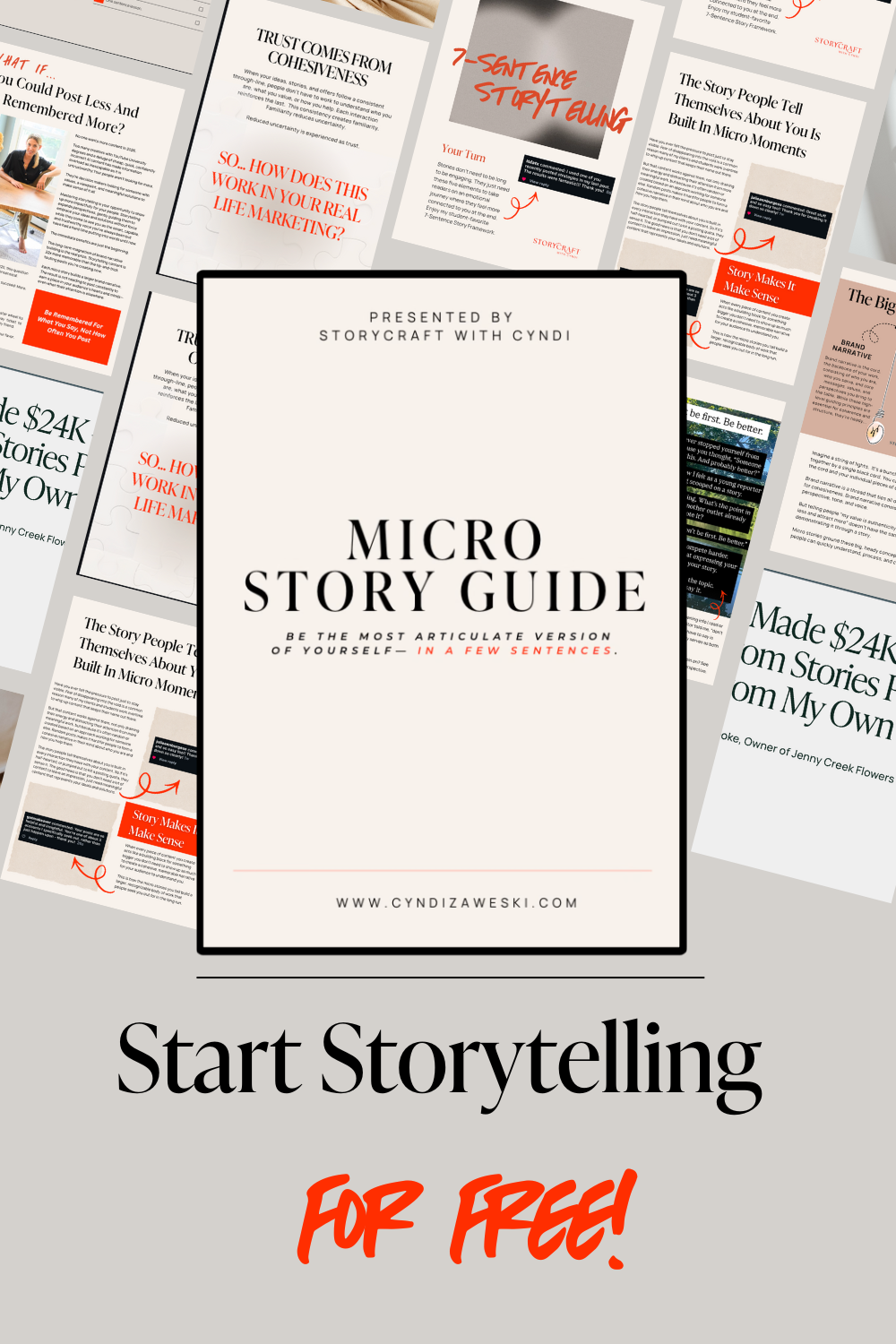
That’s why I put together this free Micro-Storytelling Guide so you can implement these emotional storytelling ideas in your short-form content. In as little as 15 minutes you can go from “I sorta have a story idea” to hitting publish on an emotionally-relevant post makes your brand message memorable and trustworthy.
In this free guide, you’ll get:
The three types of emotionally-relevant micro stories
My viral 7-Sentence Storytelling Framework For Social Media
How to tell stories that feel like you — and take only a few minutes to write
Cherry On Top: you can log off with the peace of mind that you won’t be forgotten, because storytelling is 22x more memorable than regular posting.
Thanks for reading!

Cyndi Zaweski, Owner of StoryCraft
Cyndi Zaweski is an independent journalist and the owner of StoryCraft. She writes primarily about how narrative influences behavior, exploring how storytelling, belief, and perspective drive action through the lenses of marketing, philosophy, psychology, technology, spirituality, and beyond. Her brand story clients have been featured on CBC, iHeartRadio, The Minimalist Podcast, and more.
Emotional Storytelling For Short-Form Content FAQs
-
The secret is to start as close to the climax as possible. You don't need three paragraphs of backstory. Instead of describing the whole week, describe the three seconds when you realize everything was going wrong.
Specificity is the shortcut to brevity without losing emotion.
-
Manipulation is using emotions to trick someone into doing something that isn't in their best interest. Ethical storytelling is using emotions to help someone recognize a problem they already have and a solution they actually need. If you are naming a feeling they are already experiencing, you aren't manipulating them—you're acknowledging them.
-
In business, "small" is actually better. You don't need to have survived a mountain lion attack to be relatable. A story about a frustrating phone call or a morning where you felt completely unmotivated is often more effective because it’s something your audience actually experiences and can relate to on an emotional level.
