How Write Instagram Headlines (With Story Hooks)
Last Modified: March 2026

How To Write An Instagram Headline
If you’ve ever spent an embarrassing amount of time making an Instagram post look good, only for it to get ignore... hi, welcome. You are very much not alone.
A lot of times, it’s not because your content ideas suck or you’ve got a boring story.
It’s because the headline didn’t do its job.
And I say that as someone who still gets newsroom flashbacks when I hear the word headline.
I started my career as a journalist. I can practically hear the clinking of ceramic mugs as we huddled around a conference table, obsessing over that one perfect line for the front page. We knew that if we didn’t get that passerby to stop in their tracks and reach for the paper the next morning, our stories—the ones we worked so hard on—would never be told.
That part hasn’t changed.
The platform has changed. The format has changed. The attention spans have definitely changed. But the job of a headline? Still the same.
In 2026, your Instagram cover is your front page.
It’s annoying but true that 8 out of 10 people will only read your headline.
That means your Instagram cover slide is doing 80% of the heavy lifting for your engagement.
In this article we’re gonna cover how to write engaging Instagram headlines, but first we need to clear up one thing that gets mixed up all the time:
Your Instagram headline and Instagram hook are not the same thing.
Let me clear up the jargon and show you how this looks in real-life:

Instagram Headline vs. Instagram Hook
This is one of those small distinctions that makes a huge difference when you’re at your desk writing content for Instagram.
Your headline is the text on your first Carousel slide or Reel cover. The hook is the first line of the caption that shows before they click “more.”
They work together, but they do different jobs.
It’s just the way the human brain works.
The first thing you’re going to read is the headline. It’s big, it’s bold, so naturally, that’s where your eye goes to immediately.
Then your gaze moves to the subhead. These are an optional line or two of context for the main the headline.
Finally you’ll get to the caption hook. It’s small but mighty.
If your headline gets the scroll to stop, your caption hook gets them stay til the end —you know so they actually read your message.
If you’re done wasting time on headlines and hooks that don’t work, this blog will walk you through how to write engaging open lines.
Here you’ll find:
Copywriting Tips For Engaging IG Cover Headlines
Fill-In-The-Blank Instagram Headline Writing Prompts
How To Weave Storytelling Into Your Hooks And Headlines
Instagram Headline Writing Formulas With Story Hooks
Now that we’re past semantics. Let’s move on to words. Specially the words that will make your Instagram headline do its job: stop a thumb mid-scroll.
Here are a few tried-and-true headline writing formulas with examples. I’ll touch on why they work so you can write one-liners for your brand.
Headline Writing Formula #1: The Curiosity Gap
If you’ve ever found yourself clicking on an article solely because the title started with "The one thing no one tells you about..."— you’ve fallen for the Curiosity Gap.
Simply put: It is the space between what we know and what we want to know.
When you create a "gap" in your Instagram headline, the human brain feels a twinge of psychological discomfort until that gap is closed.
That twinge is the emotional reaction to uncertainty. We just hate not knowing.
The only way for your reader to close that gap (and get the answer) is to focus in on what you’re saying.
Headlines with a cliffhanger curiosity gap often go in this direction:
[The Specific Result] + [The Mystery Factor]
But they take many forms:
The "One Thing" Formula:
Headline Example:"I talked to your sourdough starter, and this is why it’s dying"
Why it works: They know they’re killing their sourdough starter, but they don’t know why. Now they need to find out.
The "Secret" Formula: [The Gatekeeper] + [The Hidden Truth]
Headline Example:"The lie productivity experts fell for, and pray you to keep believing."
Why it works: It implies there is "insider" knowledge they’ve been denied. It makes them feel like they’re about to get the "real" story that everyone else is missing.
The "Stop" Formula: [The Common Habit/Tatic] + [The Warning]
Headline Example:"Stop using hashtags if you to want to get found on Instagram."
Why it works: It creates immediate "FOMO" (Fear Of Missing Out). It makes them think, "Wait, am I doing that? Is that why my reach is down?" They have to read on to fix the mistake.
Headline Writing Formula #2: The Transformation Story Hook
Success for today’s audience is less about what they have and more about how they are. This formula is all about the transformation statement. You are telling the reader exactly who they get to be if they pay attention. Here are a couple of headline writing formulas that show the transformation.
The "Simple Shortcut" Formula: [Small Number] + [Massive Result] + [Minimal Effort]
Headline Example:"3 ways to be a present mom (without sacrificing your career)"
Why it works: Numbers are the ultimate headline writing hack. Research shows numbers in headlines instantly make content sound more credible. This is another psychology thing. Readers assume they’ll learn or benefit from following the advice in a numbered article. Another reason people like numbered headlines is that they’ll know what to expect. A lower number = a shorter read. But the real magic is in the second half. By adding "without sacrificing your career," you’re touching on the tension of who they are right now: the woman who feels like she has to choose between her children’s memories and her own ambition.
The "Then vs. Now" Identity Formula: [The Old Belief] + [The New Wisdom]
Headline Example:"At 18, I thought going to bed at 9 p.m. was a sign you gave up on life. At 38, I wondered what took me so long."
Why it works: This functions similarly to a curiosity gap, but there’s more closure and a less obvious cliffhanger. I call this headline writing style “Two Sentence Storytelling” because it has everything you need to set up an engaging story for Instagram: The Before and The After. By leading with the beginning and ending point of the transformation, you’re hinting that there is much more to the story, which compels people to dive into the caption to find out what happened for that shift to occur. This positions you as someone with personal experience worth listening to. In this case, it’s relatable but authoritative. If a reader is feeling conflicted about something—like aging or burnout—you’ve just told them you’ve already navigated it and come out on the other side. It’s a trust-builder.
Headline Writing Formula #3: The Bold Statement Story Hook
Bold statement headlines are your drop the mic moment.
A couple examples of headlines with bold statements I’ve used over the years to stop hundreds of thousands of Instagram scrollers:
No minced words here. Bold headlines are direct truths people feel in their bones but never voice. Sometimes they take the form of a counterintuitive truth that hits like a cognitive speed bump. The words go against the status quo so much that people have to physically slow down and reconsider what they thought they knew.
Sometimes it’s more of a “dang, she said it” vibe. But they can fall into clickbait-y “hot take” territory is your claim isn’t backed up an equally mind altering message. Bold statement headlines are not formulic because unspoken truths don’t come from a 1 + 1 = 2 equation. They come from a deeper place. Still, there is structure to this headline writing style.
Let me show you.
Bold Headline Example For Instagram #1

The "Counter-Intuitive" Narrative
Headline Example: “Steve Jobs Sucked At Storytelling”
The Brand Message: This viral carousel post got more than 20,000 views in the first 24 hours after it was shared, and went on to reach thousands more in the months after. It all started with a brand message core to the StoryCraft community: You don’t have to be a natural born storyteller to be a great storyteller. Let me break down the strategy behind the viral headline.
The Storytelling Strategy: This headline a pattern interrupt in its purest form. Because the world has canonized Jobs as the ultimate communicator, the headline blows expectation out of the water. It makes the reader question what they know. Uncertainty is like gravity, it pulls people in.
This storytelling Carousel goes on to solidify my brand message by sharing a micro narrative about Jobs’ journey from terrible storyteller to earning storytelling God status.
Did you know that before Job’s legendary "1,000 songs in your pocket" era, there was the LISA era— with a nine-page, jargon-filled New York Times ad that flopped so hard it essentially got him fired from his own company?
Showing that even the world’s greatest storyteller had to "fail" his way into Pixar-level clarity, gives my reader the warmest feeling of all: Hope. It meets them at the moment of frustration "I'm just not good at storytelling" and leads them to a feeling of empowerment "I can learn this too."
This headline is a trust-builder. When you're willing to say the thing that no one else is saying, you immediately position yourself as an expert with a unique perspective. It tells your audience that you aren't just regurgitating what you’ve heard elsewhere—you have original ideas they can’t get anywhere else. You won’t even have to ask them to follow. They’ll want to.
Bold Headline Example #2

The Teach Without Preaching Structure
Headline Example: “When You Keep Showing Up People Notice. But You Have To Show Up For Yourself First”
The Brand Message: This headline inspiration came from a local coffee shop. I learned the lesson, "When You Keep Showing Up People Notice. But You Have To Show Up For Yourself First," when a barista came over after five weeks of seeing me at the same table, doing the same work. She told me my consistency was "inspiring" and gave me a coffee on the house.
The Storytelling Strategy: When people sense the emotion in your message, they feel it too. And stop to read it.
Perhaps like you, my community on Instagram is exhausted by the "hustle culture" of showing up for the algorithm, for the likes, and for the strangers.
This headline pivoted that expectation—stating that the real power comes from showing up for yourself first. It wasn't just a clever hook. It was an unspoken truth that they felt in their bones but hadn't given themselves permission to voice.
All good storytelling is about articulating change, emotion, and meaning. I mentally note the little moments that light me up and think about why they had an impact.
I question the "cause" behind that emotional shifts and reactionary behaviors in my day. In this case, I realized the barista only noticed me because I had already spent five weeks showing up for myself before anyone else was watching. By noticing how my emotions and behavior shifted, I caught a deeper value of mine in action: Sustainable productivity.
This is a bold statement people feel in their bones because it isn't a "hot take" for the sake of going viral. It’s an original, memorable brand message that only came because I was willing to slow down enough to hear myself.
Did You Catch The Bigger Pattern In These IG Headlines?
If you look closely at these three IG headline formulas, you’ll notice a fundamental shift in the way we communicate.
Detached "How To" headlines that once dominated the internet can't stand up to a personal "How I." Old-school headline formulas are just that—old school. They were designed for a world where information was scarce and a "5-step listicle" was a goldmine.
But today? Information is a commodity. AI can give your audience the "facts" and the "5 steps to success" in a heartbeat. What AI can’t give them is your personal touch.
The only way to stop them is with your perspective.
If you’re ready to tap into your voice and articulate the messages only you can say, I’ve got the toolkit to put thoughts to words.
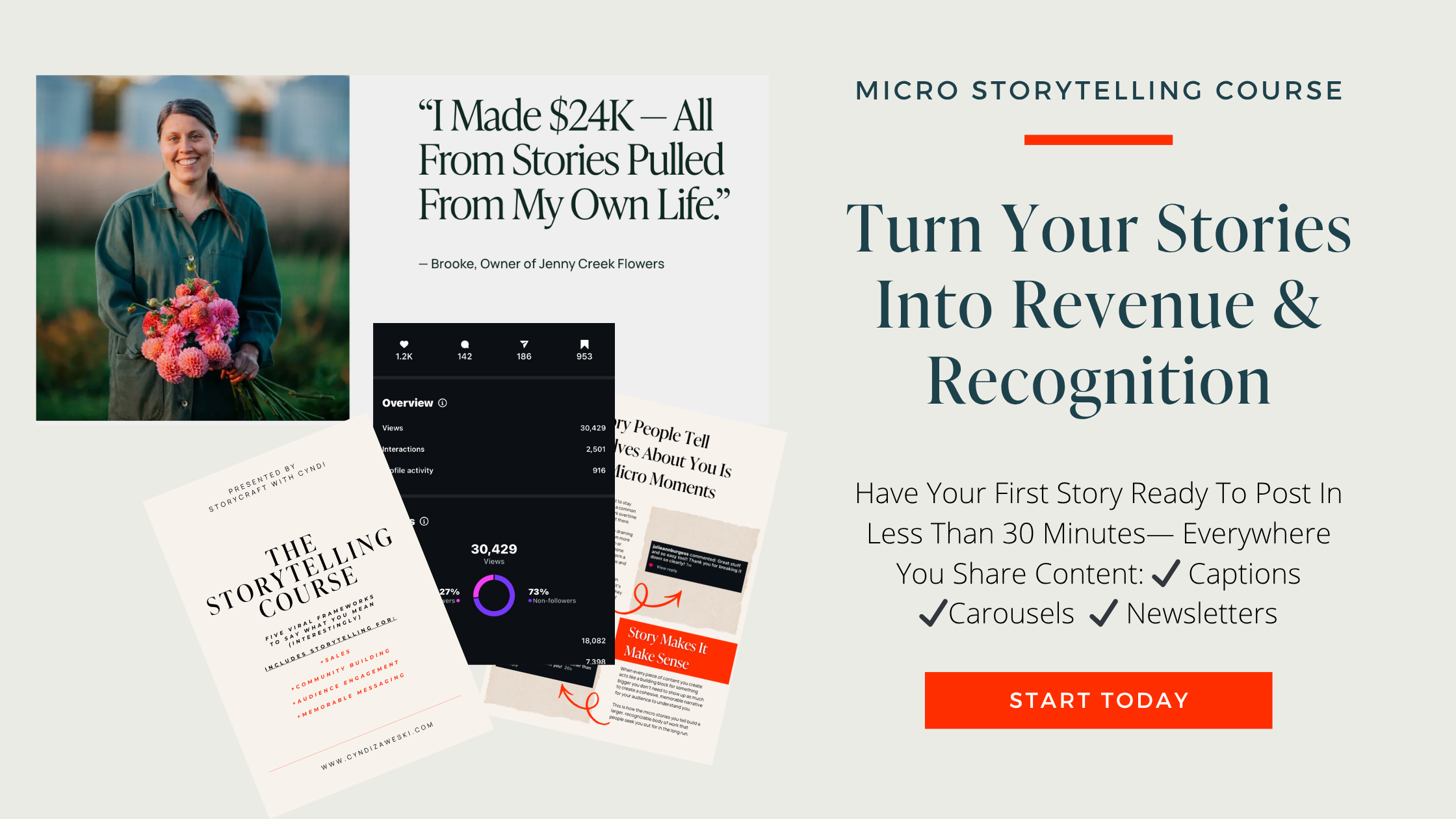
Inside my Storytelling Course, you get instant access to my viral storytelling templates to turn your wisdom into a one-of-a-kind magnetic brand people feel instead of scroll past.
Here is exactly what’s waiting for you inside:
75+ Fill-in-the-Blank Storytelling Hooks: Viral hooks that unique perspective across Instagram, newsletters, or wherever you show up.
5 Micro Storytelling Templates: A headline is only the beginning. I show you exactly how to write entire storytelling posts and newsletters—from first line to CTA.
Storytelling That Voices Your Message: I’ll teach you how to look at your daily life—the coffee shop runs, the tough DMs, the small wins—and find the meaning that disrupts the status quo.
Who you are and what you’re meant to say aren’t different things.
It’s time to say it loud and proud the way only you can.
Thanks For Reading!

Cyndi Zaweski, Owner of StoryCraft
Cyndi Zaweski is an independent journalist and the owner of StoryCraft. She writes primarily about how narrative influences behavior, exploring how storytelling, belief, and perspective drive action through the lenses of marketing, philosophy, psychology, technology, spirituality, and beyond. Her brand story clients have been featured on CBC, iHeartRadio, The Minimalist Podcast, and more.
Instagram Headline FAQs
-
While traditional advice says to aim for six words, digital storytelling headlines often break this rule in favor of deeper emotional connection rather than scroll-stopping shock value.
The goal isn't short—it's scannable.
As long as your typography makes the hierarchy clear, a longer, narrative-driven headline will outperform a short, generic one because it offers a unique perspective readers don’t see anywhere else.
-
The difference between a hook and clickbait is the delivery of the promise.
To avoid clickbait, ensure your headline is backed by an equally powerful message or a personal micro-narrative that backs up your claims and delivers on what the headline is about.
-
Numbers provide a psychological shortcut for the brain. They imply that the content is organized, credible, and—most importantly—finite. A headline like "3 ways to be a present mom" tells the reader exactly how much time and energy they need to invest before they get a benefit.
-
The most popular hooks on Instagram have shifted away from generic, clinical "How To" listicles toward story-drive "How I" narratives. This shift is a direct response to the rise of AI-generated content; while AI can provide facts and "5 steps to success" instantly, it cannot provide the personal touch or insight of a human storyteller.
-
An Instagram headline is the text placed directly on your Reel cover or the first slide of a Carousel. Its job is to stop the scroll visually. An Instagram hook is the very first line of your caption. While the headline gets them to stop, the hook gets them to click "more" and engage with your story.
-
Yes! One of the smartest ways to extend the life of your content to keep the meat and swap the hook.
Choose a topic, grab a pen, and give yourself options by playing up—or down—different angles of the same story. This exercise makes it easy to repurpose a single post for different "buyer types" or emotional states:
One That Appeals To Emotion:"How To Stop Waking Up Drained"
One That Uses Data/Numbers:"7 Science-Backed Ways To Wake Up Refreshed"
One That Offers An Actionable Solution:"Try This Tip For More Restful Sleep"
By simply swapping the headline, you can resharing the same core message while catching the eye of someone who missed it the first time because they needed a different entry point.