
What Is Narrative Strategy? Your Guide to Creating a Cohesive Brand Narrative With Storytelling Marketing

What Is Narrative Strategy?
Most entrepreneurs find their way to narrative strategy after they’ve tried everything else.
The 30-day Reel challenges.
Showing up c-o-n-s-i-s-t-e-n-t-l-y on every platform.
Buying someone else’s proven framework and trying to force it to fit.
Maybe some of it worked.
Perhaps you got some visibility, a little growth, a few more likes than usual—and that felt like progress… for a hot second.
But something still feels off.
Your content is getting seen, but not always understood. (You can tell because “likes” aren’t translating into more).
You’re showing up a lot to stay visible, but it’s draining you more than it’s differentiating you in increasingly crowded feeds.
The work of marketing is taking more energy and dedication than the work you actually care about and want to be known for.
What’s off is not your work ethic, consistency, or even the quality of your ideas.
The hard truth is we’re living in a system that rewards speed over quality, metrics over meaning, and hot takes over actually helping people.
Most content marketing advice today tells you to keep posting until something pops off and proves you’re worth listening to.
I think you already are.
The result of this backwards system is credible business owners with meaningful work end up buried beneath louder (but not necessarily more authoritative) voices, clickbait hooks, and content engineered to grab attention—not serve.
If you know traditional content marketing isn’t sustainable for the kind of impact you actually want to make, it’s time for a new approach.
Narrative strategy is a human-centric, storytelling method that puts the focus back on showing up intentionally in service of others, so you can attract clients and opportunities that match the level of expertise you’re bringing to the table.
Narrative strategy tells the story of the transformation your work creates.
Instead of pumping out disconnected posts to stay visible, you organize your message around that change so people understand on a bone-deep level what you do, why it matters, and how it helps them.
What follows is a step-by-step guide to creating a brand narrative strategy and implementing it through storytelling marketing.
By the end of this article you’ll know:
Step-by-step how to create a brand narrative strategy
The most common brand narrative strategy mistake (and how to avoid it)
How to use narrative pillars to organize content into a cohesive body of work
How to use storytelling marketing and micro storytelling to use your brand narrative in everyday content
Before we dive in, let’s get one thing straight: Posting into the void is NOT acceptable for an expert of your caliber.
Let’s change that, starting right now.
How to Start a Narrative Strategy

Step One: Identify Your Brand Transformation Statement
If you want to be known for how your expertise helps people, it makes sense to start with how you help.
Not just for your brand’s sake, but for your audience’s too.
This is really important to know so imma give it to you straight:
Success for today’s audiences is less about what they have, and more about who they are.
That’s why identifying who your audience becomes by working with you is central to your storytelling strategy. Yes, customers and clients will absolutely care about tangible deliverables they get when they work with you. But before they’ll even consider making a purchase, they need to feel on a bone-deep level that paying you and paying attention to you is going to get them closer to the version of themselves they aspire to be.
I’m a narrative strategist, so allow me get a little nerdy with you for a sec to explain why this matters if you want a sustainable approach to be the heart of you brand. What you need to know is:
At the center of any narrative—whether it’s a novel, a speech, or a brand—is change. Something is different at the end than it was at the beginning. Without that shift, there isn’t really a story. That’s why…
A narrative strategy starts by defining the transformation your provide in very clear terms.
Most entrepreneurs skip this step, jumping right into making content. That choice snowballs into a massive waste of time and energy.
It’s the most common brand narrative strategy mistake. And it is also easily avoidable.
There is a prompt to write your brand transformation statement below, but it all begins with this question:
Where is someone before they encounter your work, and where are they after?
Everything else is an extension of that core brand narrative:
The stories you tell.
The ideas you champion.
The approach that’s unique to you.
The offers you sell, the books you write, the keynotes they can’t stop thinking about.
All of these touch points exist to help people go from they are now to where they aspire to be.
Because with a narrative strategy each piece of content supports a different part of the transformation: From helping people recognize the problem, to understanding who they’ll become when they listen to you, and trusting your approach enough to act (even if they’ve tried other approaches before without success).
But before you can organize your content or know the right business stories to tell, you need to clearly define the transformation your work provides.
Storytelling Strategy Prompt: Write Your Brand Transformation Statement
Every narrative strategy begins by spelling out the transformation your work creates.
You can think of it as the north star, big vision, ultimate intention for the people who work with you.
That transformation has two parts:
The Before
The After
Because this brand transformation statement is so core to your messaging, you want it to hit on multiple levels:
Logically
Emotionally
Aspirationally
But just because it’s rich in context doesn’t mean it needs to be bloated with extra words.
The goal is to keep it concise, relevant, and as clear as day.
Let’s write yours together.
Don’t be shy about grabbing a notebook or opening a Google doc to start right now.
You can always tweak it later, but the first step is to get a draft on the page.
Define “The Before”
Who is your audience?
What is their current situation?
How are they feeling about their current situation?
For example:
New moms who left meaningful careers and are struggling to find meaning and purpose.
Let’s break down this brand transformation statement example:
Who is your audience? New moms. Not moms with teens. Not empty nesters. Very specfically, new moms.
What is their current situation? They left a career to raise a family. They’re not working moms, they’re not planning to go back to work.
How are they feeling about their current situation? Struggling to find meaning and purpose. Yes, they’re probably tired, they’re probably overwhelmed but that is not the single, specific core emotion we’re addressing in the overall transformation statement of this brand. Those supporting emotions will be important to know later in this process (I’ll walk you it through it in the narrative pillar section below), but for right now it’s more important for you to be extremely specific.
Pro tip: If you have a hard time defining any one of these elements, define what they aren’t (like I did in the example). That will give you clarity on what they are.
Define “The After”
a hopeful, achievable future is the secret Behind empowering content
What skillset, mindset, or deliverable to they gain from following your approach?
How does that benefit them practically?
How does that benefit them emotionally?
What future success does that set them up for?
Empowering content attracts. And the secret behind empowering content is a hopeful, achievable “after.” If you want to create a community, brand narrative strategy will fast track the process—not by using other creator’s “proven” strategies but by building one custom to the transformation your brand creates. Because success for today’s audience is less about what they have and more about who they are.
That’s why identifying who your audience becomes by working specifically with you is central to your storytelling strategy.
Let’s continue with the above brand transformation statement example:
Through a community of monthly meet ups, moms will finally have space for themselves to explore what will make this chapter of life more meaningful than the last. This membership gives new moms the tools they need to define themselves in the presence of other moms who have been there. With community, structured guidance, and having a dedicated time and space to nurture themselves, new moms can be the most on purpose version of themselves for themselves and for their families.
Let’s break it down:
What skillset, mindset, or deliverable to they gain from following your approach? With a community, new moms have find meaning after leaving their careers.
How does that benefit them practically? They gain a space for themselves, tools to define themselves, a built-in group of moms in the same boat (friends!)
How does that benefit them emotionally? They’ll feel supported and empowered that this season of live can be more meaningful than last.
What future success does that set them up for? They’ll feel fulfilled, purposeful, and connected so they can be a happier person and better moms.
Now use this prompt to summarize the shift in one brand transformation station:
I help/give/ provide [type of person] move from [situation + emotion] to [new capability + emotion] so they can become [aspirational feeling/situation].
Example:
I give new moms who feel lost after leaving meaningful careers to raise a family a space to nurture themselves so they can be the most alive, purposeful, and fulfilled version of themselves,
This big picture brand transformation is the backbone of your narrative strategy.
Once it’s clear, every idea you share, story you tell, and approaches you teach reinforces that core point.
But how does that work in real life?
Next we’ll dive into content planning using a narrative strategy so you’re never at a loss for what to say and when to say it.
This type of content organization gets into the details of how you create the transformation so you have specific, authoritative, emotionally resonate pieces of content for blogs, newsletters, podcasts, and social media posts, like Instagram Carousels.
Content Planning with a Narrative Strategy
Most business owners create content platform-first instead of narrative-first.
They post based on:
• Trending topics
• What others are doing
• What the algorithm favors
The trap is how productive this feels at first.
But over time it becomes exhausting.
Ideas run dry.
Posting starts to feel like an obligation instead of an expression of your thinking.
And despite all the effort, nothing seems to build real momentum.
Most assume the problem is tactical.
They think they need:
• A better content calendar
• A more intense posting schedule
• A new content marketing system
But it’s really a narrative clarity issue.
Without a narrative strategy you end up:
• Sounding like everyone else’s
• With random, disjointed content
• Feeling like you’re constantly trying to keep up
The benefits of content planning with a narrative strategy include:
Clear, Cohesive Brand Messaging: You’re no longer starting from scratch with every post. Your communication has purpose and direction. Because each piece of content connects to the transformation your work creates, you attract a motivated audience who understands how you help them.
Perspective, Brand Differentiation & Recognition: Now that your content consistently reinforces the same transformation, people begin to recognize your perspective. They associate your name with a specific way of seeing the problem. Think: Brené Brown and vulnerability. That kind of recognition does more than make your brand memorable. It attracts opportunities to go bigger. I’m talking about an easier time booking speaking opportunities, a more enticing book proposal, and more control over who you work with—and when.
Selling Stops Feeling Icky: Storytelling for sales isn’t forceful with narrative strategy behind it. Because your content is doing the work before the conversation ever happens. By the time someone reaches out, they already understand the problem, trust your perspective, and believe the transformation you provide can help them.
A Respectable Body Of Work: Social media posts age like milk, losing their value almost as soon as they’re published. That kind of content asks you to work hard for something that disappears fast. It’s draining to keep pouring time, thought, and creative energy into posts that feel irrelevant a week later. A narrative strategy changes that equation. Now, the work you create keeps building your brand long after the post is live. What you make today still matters tomorrow. And next year. And five years from now. There’s real relief in knowing your content isn’t disposable—that it continues strengthening your online presence over time.
Post Less, Be Remembered More: Imagine being free of the pressure to show up daily on Instagram. With a narrative strategy, you won’t have to post every day to stay relevant. Because storytelling is 22x more memorable than information alone, fewer pieces of content can leave a longer-lasting impression. That’s a big ol’ permission slip to let go of the guilt of not constantly being “on” and release the whole idea you need to turn your life into content in the name of staying visible. Instead of burning out on constant output, your stories stay with people—lingering in their minds and hearts.
All of this raises the next logical question: How do you actually plan content that feels this cohesive?
The answer is narrative pillars: a structure for your core messages with a storytelling throughline that organizes content, deepens your perspective, and reinforces the transformation your work delivers. Let’s dive in:
What Are Narrative Pillars? (And How To Choose Yours)
Step Two: Organizing Content With Pillars
What’s the Difference Between Content Pillars and Narrative Pillars?
| Content Pillars | Narrative Pillars |
|---|---|
| Broad themes | Specific perspectives |
| Sort content into categories | Organize content around a clear message |
| Topic-based | Point-of-view-based |
| Example: “marketing” | Example: “modern marketing fails experts” |
If narrative strategy defines the transformation your work creates, narrative pillars are the structure that helps you communicate that transformation clearly.
In my approach, narrative pillars are 3 to 5 messaging pillars built around your perspective, values, tone, mission, and vision.
Each one is rooted in a unique-to-you point of view on the problem your audience is facing at each stage of the transformation your work helps create. That perspective is what makes a pillar specific, unlike vague content pillars that center on broad category like mindset, marketing, or leadership.
The problem with vague categories is that they aren’t special to your brand. They are interchangeable with anyone with your skillset.
But you are more than your skillset.
What will attract the right people is not what you know but the perspective you bring.
What Narrative Pillars Include:
| Part of the Pillar | What It Does |
|---|---|
| Perspective | Defines your point of view on the problem or transformation |
| Core Brand Story | Gives the message context, proof, and meaning |
| Audience Pain Points | Connects the message to what your audience is feeling or struggling with |
| Framework, Approach, or Offer | Makes the message practical and usable |
People do not need more information.
They need someone with experience, judgment, and a point of view strong enough to help them make sense of what they’re seeing.
Narrative pillars organize your message around the way you see the problem, the way you approach the work, and the larger story your brand is telling.
Each pillar speaks to a message your audience needs to hear at that stage of transformation.
Per our moms with meaning example, the first pillar would be a message they need to hear when they’re stuck in the before. For most of my clients, this is a validating message that pushes back against the status quo: such as “New moms shouldn’t have to face a crisis of meaning alone when they leave careers to start a family.”
The second pillar could be a reframe your audience needs to hear in order to become receptive to your solution.
The third could be a bold point of view that captures the aspirational end-game transformation you provide.
Because narrative strategy isn’t a plug and plug system, it differs depending on the brand. But all the pillars must be rooted in your unique view point.
That perspective might take the form of:
A status quo you challenge: New moms face a crisis of meaning when they leave careers to start a family
A reframe your audience needs: New moms can have more meaning after they leave their careers
A bold point of view that captures why your approach is different: Moms who feel on-purpose have the power to change the world
Long story short: A narrative pillar isn’t just a subject you talk about.
It is a perspective helps people understand what you believe, what makes your work different, and why your message is relevant to them now.
That level of specificity matters because it makes your message memorable.
It also makes your content easier to create, because you are not pulling from vague themes and guessing what to write about them.
Each pillar is illustrated by a core brand story.
This is a central, repeatable story that validates your point of view, explains the deeper why behind your offer, or reveals the origin of your brand.
Think about the stories certain creators become known for. One core story example is Jenna Kutcher’s $300 Craigslist camera story.
Jenna constantly repeats this story on blogs, newsletters, and in her podcast intro because it helps people understand her brand, her beginnings, and what she stands for. Yet no one is sick of it because it’s rich in context, meaning, and emotional resonance.
But in my approach to narrative strategy, a strong pillar does not stop with your perspective and your story.
Effective communication starts with knowing your audience and meeting them where they are. If you do not understand what your audience is feeling, fearing, assuming, or misunderstanding, it becomes much harder to say the right thing at the right time in their journey.
That is why I ethically address pain points directly into each pillar. (See a photo of my narrative pillar structure below)
This is where we get granular into how going through the transformation feels for them.
Per our moms example, that would include addressing issues of loneliness, overwhelm, and exhaustion.
Finally, each pillar also includes a practical element: a framework, method, or freebie/offer.
This connects the dots between your message and working with you so you get paid for your expertise.
Narrative Pillar Example
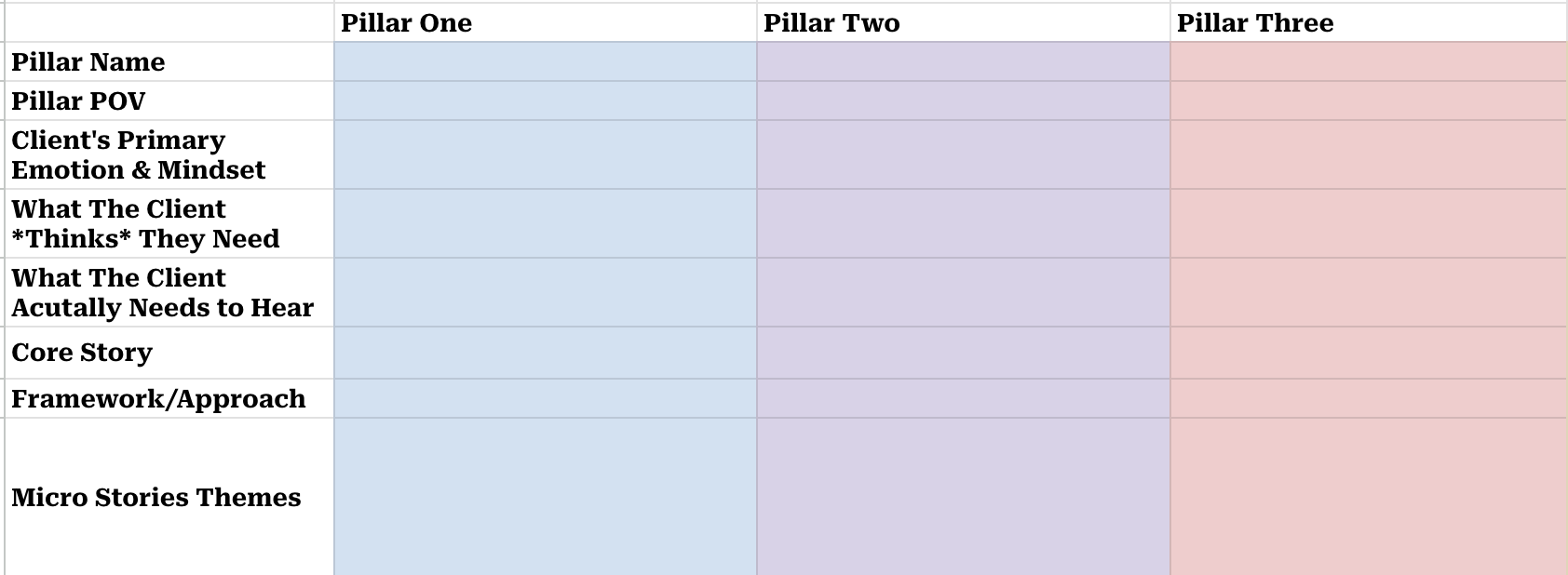
This is the structure I use as a starting point for brand narrative pillars.
How To Pick Your Brand Narrative Pillars
Start with your brand transformation statement.
Then ask:
What are the stages of the transformation?
Most brands need 3 to 5 narrative pillars representing each stage. Once you have their journey from before to after mapped, each pillar should have sections (see photo above) with the details you need to communicate effectively at each stage of the journey. They should be:
Specific, not broad. “Mindset” is too general; choose a clear reframe or point of view is specific to you.
Rooted in your perspective: The pillar should reflect how you see the problem or approach the work.
Supported by a core story. There should be a story you can return to that helps explain why this message matters.
Connected to your audience’s inner world: The pillar should speak to the fears, assumptions, or stories they are already telling themselves
Practical enough to teach from. Each pillar should lead naturally to a framework, method, or offer that executes on your unique approach—because we’re not just leading people down a path to learn from you, we are leading people down a path to buy from you.
By the end, your pillars should amount to a quick reference for what to say, when to say it, and how to say it across your social media content, sales pages, website copy, newsletters, podcasts, Substacks, or wherever you choose to share your message.
Ultimately, this structure means no more wasted time creating content for content’s sake without a return on investment.
Flow follows foundations.
As someone who's done hundreds of narrative strategies, I recognize how much thought goes into creating a custom plan that truly reflects you. But the depth of the work that needs to be done to create it is required up front so your message is easier to share in the long run.
For recognition, you have to be able to articulate why your audience needs your message now.
For emotional connection, you have to know the most interesting ways to tell your stories.
For authority, you have to be able to explain the nuanced ways your approach is different.
The things that are so obvious to you they nearly go unnoticed are often exactly what your audience has been waiting to hear from you.
Using Storytelling Marketing In Your Narrative Strategy
Step Three: Reinforcing Brand Narrative Through Micro Storytelling
Narrative strategy and storytelling marketing often get used interchangeably, but they are not the same thing.
Narrative strategy is the structure behind the big picture transformation your message.
Storytelling marketing is the practical step of sharing the big picture into actual content.
Without a narrative strategy, you might share interesting stories, but they don’t feel relevant or contribute to your goals.
Without storytelling marketing, narrative strategy stays theoretical. Let’s face it, telling people “my point of view is rooted in authenticity” or “my core message is do less and attract more” doesn’t have the same magnetism as telling a story that demonstrates it.
Storytelling marketing, specifically micro stories, ground big, heady concepts into tangible nuggets people can quickly understand, process, and connect with.

You can think of your brand narrative like the cord and your individual pieces of content like the lights. Brand narrative is a thread that ties all of your individual content together for cohesiveness.
A micro story is exactly what it sounds like: a short story, usually 2–10 sentences, pulled from lived experience (you can see a micro story example in the section above inspired by a compliment a client gave me).
It captures a small moment that reveals something meaningful about your perspective, your work, or the problem your audience is facing.
Micro stories might include things like:
Something a client said to you
A realization you had while working on a project
A small moment from your day that illustrates to your message
Micro storytelling example: “I somehow overcooked and undercooked pasta at the same time, and it reminds me why good things require your full attention.”
A past experience that shaped how you approach your work
Something your heard on a podcast, read in a book, saw on your favorite HGTV show.
On their own these moments may feel small and unimportant.
But they compound to paint the big picture—not just state it.
When micro stories consistently point back to the same perspective, they build a recognizable brand narrative.
Over time, these short stories help your audience understand:
How you think
What you value
What you believe
And why your approach is different
That repetition is what turns individual posts into a cohesive body of work that reinforce your message and make you well know for how you help.
If you want help identifying micro stories for your brand — and writing them concisely — my Micro Story Guide walks you through the process step-by-step.

Create A Cohesive Brand With Narrative Strategy
If your content has been asking more from you than it’s giving back, that is not a sign to work harder.
It’s not a sign to create more content. It’s a sign to create a more intentionally.
Because the problem isn’t that people don’t care about what you have to say.
It’s that your ideas, experience, and perspective are not yet organized in a way people can quickly understand, remember, and trust.
That is what narrative strategy solves.
It gives your brand a through-line.
It helps you stop posting just to stay visible and start creating from a place of clarity, meaning, and purpose.
It turns scattered ideas into cohesive messaging.
Random posts into a body of work.
And marketing that drains you into fulfilling communication that let’s you champion the ideas you love and support the people you’re here to help.
In a time when feeds are crowded with people just trying to go viral, people are looking for someone real.
Someone with insight that cuts through information overload.
Someone who can help them make sense of what they’re facing.
Someone whose experience they can rely to help them become the person they want to be.
You can be that someone.
Thanks For Reading!

Cyndi Zaweski, Owner of StoryCraft
Cyndi Zaweski is an independent journalist and the owner of StoryCraft. She writes primarily about how narrative influences behavior, exploring how storytelling, belief, and perspective drive action through the lenses of marketing, philosophy, psychology, technology, spirituality, and beyond. Her brand story clients have been featured on CBC, iHeartRadio, The Minimalist Podcast, and more.
Narrative Strategy FAQs
-
Narrative strategy is especially useful for consultants, coaches, founders, service providers, creatives, thought leaders, and personal brands. It helps anyone with complex expertise explain their work more clearly and create content that feels consistent across platforms.
-
A narrative strategist helps a person, brand, or company explain who they are, what they do, who it’s for, and why it matters.
They help shape the way those ideas are shared so the audience can quickly understand the full picture.
The result is that:
your message feels clear and consistent
your content connects instead of feeling random
people can easily describe your work to others
It also means:
you stop guessing what to say
you stop over-explaining
you stop changing your message every week
See everything that goes into a narrative strategy here.
-
Narrative strategy is the process of organizing your brand message around the transformation your work creates. It helps you build a cohesive brand narrative so your content, offers, and stories all reinforce what you do, why it matters, and how you help people change.
-
Narrative strategy organized your content around the transformation your work creates, people are not encountering random ideas or isolated tips. They are encountering a clear perspective, a consistent message, and a body of work that helps them understand the problem, trust your approach, and see what is possible through your work.
It makes selling feel like icky.
Your content is doing the groundwork before the sales conversation ever happens. By the time someone reaches out, they already have context. They already understand what you believe, how you help, and why your approach is different. Instead of convincing people in real time, you are meeting people who are already warmed by the story your brand has been telling all along.
That creates more ease in your business because sales starts to feel less like pushing and more like resonance.
-
Narrative strategy supports intentional marketing by helping you create content from a clear message instead of from urgency, trends, or the pressure to stay visible.
Most business owners are taught to create content platform-first. They post based on what is trending, what others are doing, or what the algorithm seems to reward. At first, that can feel productive. But over time, it gets exhausting. Ideas run dry. Content starts to feel disconnected. And even with all that effort, it is hard to build real momentum.
Narrative strategy changes that by giving your content a throughline.
Instead of starting from scratch every time you sit down to write, you create from a defined transformation, a clear perspective, and messaging pillars that support both. That makes your marketing more intentional because each piece of content has a job to do. It reinforces your message, deepens trust, and helps people understand how your work creates change.
The result is content that feels more cohesive, more sustainable, and more meaningful to create.
You are no longer posting just to keep up. You are building a body of work people can recognize, remember, and return to.
-
Content pillars are broad topic categories such as marketing, mindset, or leadership. Narrative pillars are more specific because they are rooted in your unique perspective and organized around the transformation your audience experiences through your work.
-
Narrative strategy is the big-picture structure behind your message. Storytelling marketing is how you bring that strategy to life through content such as blog posts, newsletters, podcasts, social media, and micro stories.
