Storytelling For Sales: A Non-Salesy Method To Tell Stories That Sell Your Services and products (Without The Ick)
Updated March 2026
Storytelling For Sales
The email notifications are your proof.
Sales calls are booked.
Your digital products are selling.
All the while you’re behind the scenes doing what you love because your story is doing the selling for you.
Storytelling for sales is not an aggressive pitch.
You can forget sounding like that icky sales copy that’s turned you off in the past and instead do what you’ve always wanted: Make money helping people.
Selling with story is the most natural way to motivate people to buy.
Success for today’s audiences is less about what they have and more about who they become. Using a narrative strategy that weaves together not just the features and benefits of your offer, but the transformation it provides, allows people to picture themselves achieving what they want.
This style of sales storytelling builds trust, reducing friction that prevents people from buying.
This storytelling method is a far cry from sounding like “bob the used car salesman” to your customers. Here you’ll learn the non-salesy way to sell with story.
Sales Stories For People Who Hate selling
I almost blew the defining job interview of my career because sales made my skin crawl.
It was 2017, and I was getting noticed for my writing style.
I had a knack for explaining complex topics in a way that got readers to comment on social media posts and buy our publications. It was a combination that made for happy readers and happy advertisers.
So when I was asked by a luxury lifestyle magazine to come into their downtown office to discuss an editorial position, I had a clue what to say.
Or so I thought.
The publisher was this queen of a woman.
Think Vogue's Anna Wintour meets Joanna Gaines.
Strong but warm. Effortlessly cool.
We really hit it off.
Until she asked:
“How do you find the balance between what you want to write, what our audience needs to hear, and what entices advertisers to buy space next to your articles?”
Ummmmm… ‘scuse me??
The advertisers?!
I was offended at the suggestion I’d consider them at all.
“I’m focused on telling interesting stories, and it’s not my job to please advertisers,” I said proudly.
She raised an eyebrow.
“When you work for a magazine like this one, it is your job to consider all stakeholders—not just the one you like most.”
Gulp.
Turns out writing and sharing content without considering sales is not how you operate a business.
And it’s a sobering truth that I—and so many other business owners I know—have had to bump up against.
We want to help.
We want to make money helping.
But we don’t want to ask the people we can help to pay us for our help.
The fear of sounding like Bob the used car salesman stops good-hearted people from promoting their work.
No doubt you’ve come across sales messages that make you cringe.
And no doubt you don’t want to sound anything like them.
Since I landed that editorial position nine years ago, I’ve become very aware of how we’re being sold to without hard pitches.
I’m always dissecting what works so I can replicate it.
Over the years, I’ve developed a framework based on these non-salesy sales messages.
The sales stories produced by this framework have three things in common—elements you can use today to increase sales (without the ick-factor).
For a student in my storytelling course, it played out like this:
For three years, she’d been following traditional marketing advice that left her with a knotted stomach. She dreaded the feeling of uploading a graphic of her digital product and hoping it’d turn into her mortgage payment. It felt embarrassing, awkward, and, frankly, like a waste of time because it never amounted to much.
When she started using this storytelling for sales framework, the shift wasn't just in her bank account; it was in her gut.
Selling stopped feeling like a pitch and started feeling like a conversation rooted in service.
The buy button was simply the logical next step in a conversation she was already having.
Here are the three elements of selling with story she incorporated into her launch to make buying her offer feel like an obvious choice instead of another ad on the internet.
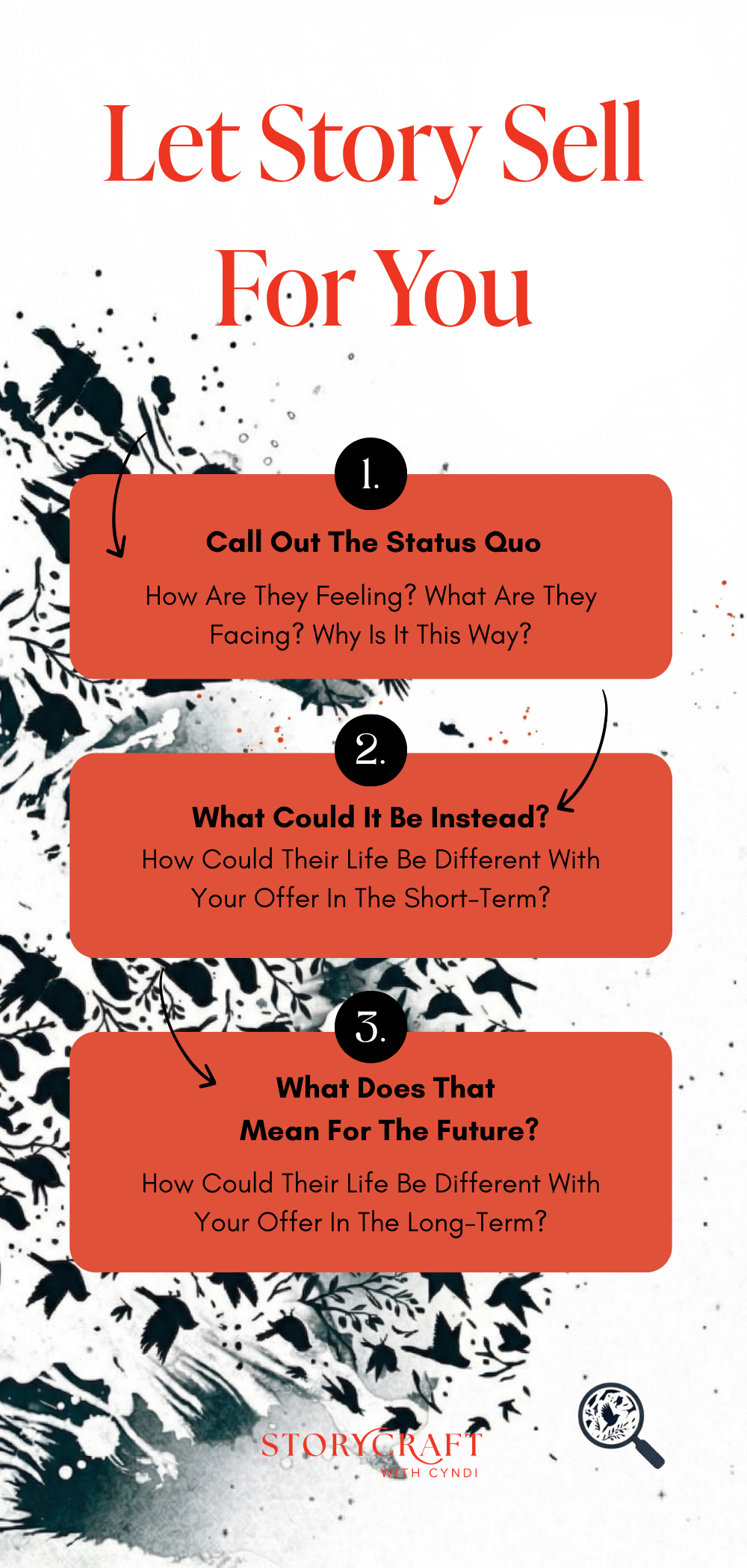
3 Musts Of Storytelling For Sales
Storytelling For Sales Framework
1. Call Out The Status Quo
She stopped "agitating" pain and started relating to her students with the empathy she’d always intended. Unlike traditional tactics, she didn’t make people feel broken for having a problem. Instead, she pointed to the root cause—not as a personality flaw, but as a flaw in the status quo.
By weaving in this context, her students felt seen and, more importantly, empowered. It wasn't them that was broken; it was the approach they’d been taught. This positioned her solution as different than anything else they had already tried—a solution that would work when others failed.
2. What Could Life Be Like Instead?
She moved beyond just listing deliverables and started mapping out the emotional ROI. She painted a picture of what life would feel like as they were solving the problem with her offer and after they stopped struggling with those old, broken methods. It wasn’t just about the tangible results; it was about the confidence, the freedom of reclaimed time, and the lightness of mental space they’d gain. What is life like on the other side?
3. What Does The Cost of Inaction Mean For The Future?
She made the stakes clear without the doom-and-gloom. Instead of "buy now or fail," she simply highlighted the cost of continuing with the status quo. She helped them realize that trying to DIY a solution using the same broken methods was costing them something more valuable than money: time. By making the invisible cost of staying stuck visible, the investment became the most logical path forward.
Lynn made $7,000 on the first day of her launch using this storytelling approach.
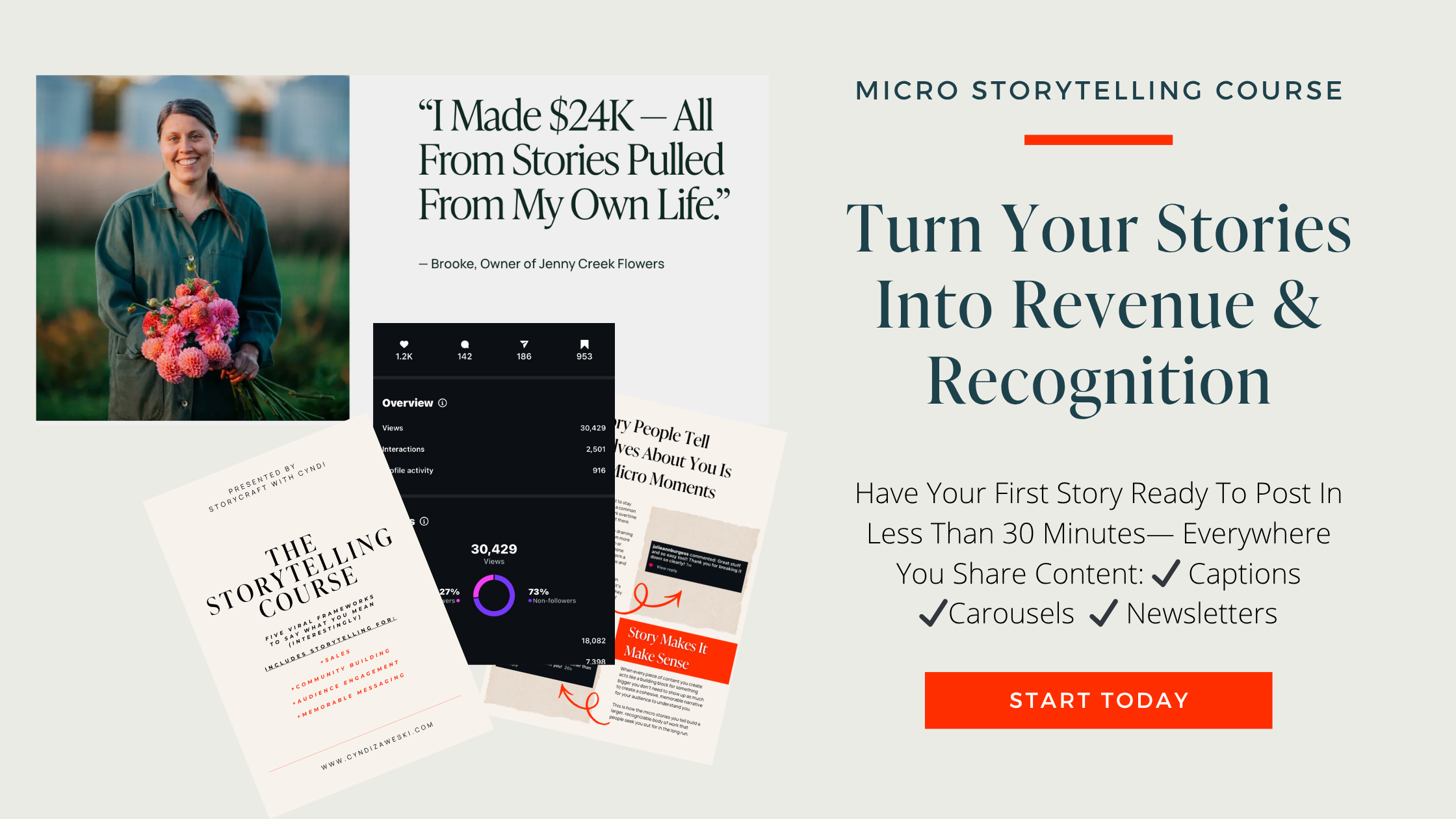
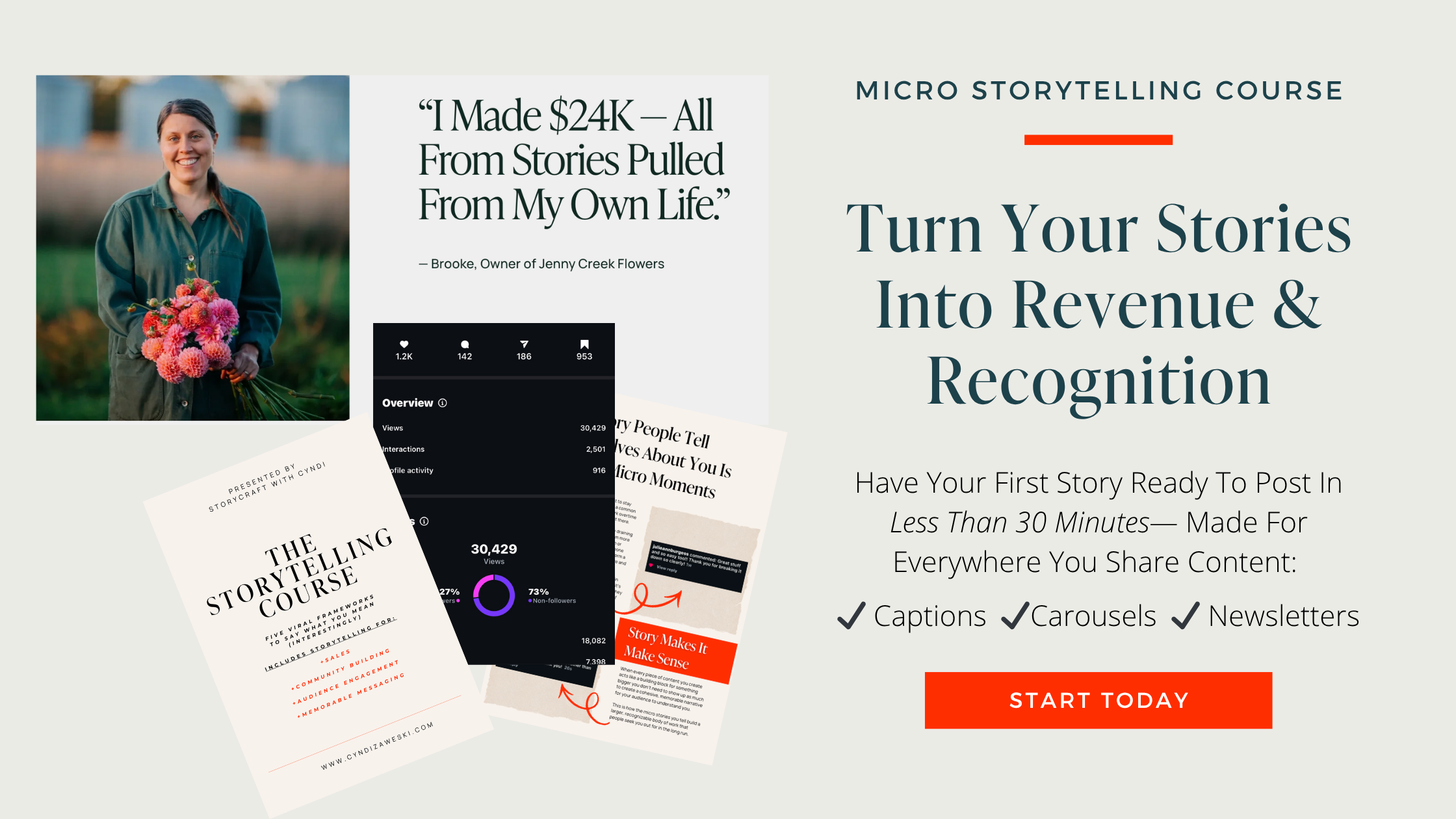
Another student, Brooke, made $24,000 in the first 48 hours of weaving stories into her launch content.
But for them, the biggest win wasn't just the money—it was finally feeling good about how they were selling. They weren't "posting and praying" anymore; they were leading a conversation they we're proud to have. In the Storytelling Course they used, I break down step-by-step how to write these sales stories and how to share them in your social media content and newsletters. Even if you’ve never told a story before, you see exactly what to say and how to say so you can automate your sales in your content.
How Storytelling Makes Sales Easier
Selling with story is 30% more effective than regular sales copy. And this is why:
When we’re 100% confident a purchase will eliminate a problem that’s in the way of living the life we envision, we’ll buy—without needing to be persuaded.
But only from a person or brand who demonstrates real understanding.
Selling Can Feel Good
It doesn’t have to feel like those cringe sales messages that turned you off in the past.
It can read like a conversation. A thoughtful way of showing people whether your solution will work for them—and helping them feel confident that you’d be a good fit.
Writing a sales story that feels as good to share as it does to read is an art. One it took me many, many years to grasp.
Which is why I boiled it down into this simple framework you can use to write and structure these kinds of non-salesy stories.
You get instant access to my storytelling for sales framework inside my Storytelling course.
Storytelling for sales is about understanding, not pressure.
They build confidence—not just in you, but in your customer’s ability to solve their problem with your expert guidance.
Tell this type of sales stories, and you’ll make sales without cringing at the copy.
Thanks for reading!

Cyndi Zaweski, Owner of StoryCraft
Cyndi Zaweski is an independent journalist and the owner of StoryCraft. She writes primarily about how narrative influences behavior, exploring how storytelling, belief, and perspective drive action through the lenses of marketing, philosophy, psychology, technology, spirituality, and beyond. Her brand story clients have been featured on CBC, iHeartRadio, The Minimalist Podcast, and more.
Storytelling For Sales FAQs
-
Storytelling in sales is the use of narratives to explain a problem, show a solution, and help buyers understand value. Instead of only listing features, sales storytelling connects your product or service to a customer’s real situation.
-
Storytelling is important in sales because it makes your message easier to remember, understand, and trust. A strong story helps prospects see how your offer fits their needs and why it matters now.
-
Storytelling helps increase sales by showing outcomes, reducing confusion, and building emotional connection. When buyers can picture the problem, the journey, and the result, they are more likely to take action.
-
A good sales story is clear, specific, and focused on the customer. It usually includes:
A relatable problem
A challenge or obstacle
A solution
A measurable or meaningful result
-
Storytelling explains value through context, while selling asks for action. In practice, good sales content uses storytelling first to build understanding and trust, then uses selling techniques to guide the next step.
-
Yes, storytelling works in B2B sales because business buyers still make decisions based on trust, clarity, and perceived risk. In B2B, the best stories often focus on efficiency, cost savings, team adoption, or business growth.
-
Yes, storytelling works in B2C sales because it helps customers connect a product to their daily lives, goals, or frustrations. B2C storytelling is often more emotional, but it still needs to be specific and believable.
-
The types of stories that work best in sales include:
Customer success stories
Before-and-after stories
Founder stories
Product-use stories
Objection-handling stories
Case-study summaries
-
A simple example of storytelling in sales is: a company struggled with slow follow-up, missed leads, and inconsistent outreach; after adopting a sales automation tool, response times improved and more leads turned into booked calls. This kind of story shows the problem, solution, and outcome in a way buyers can quickly understand.