
How to Write Engaging Instagram Captions

How To Write Engaging Instagram Captions
Do people even read Instagram captions?
In 2026, the answer is more about what is reading than who.
If we’re being honest, out of all the ways to communicate on Instagram, captions have always been the least intriguing. Images, carousels with eye-catching cover slides, and Reels are the headliners, the attention grabbers. And while that hasn’t change, the app itself has.
Ever since July 2025, when Instagram content from professional accounts began showing up in Google searches, Instagram has been a visual search engine where every word you write is a searchable. When done right, that means the algorithms will put your content in front of the people you’re hoping to reach— even months after you post.
Welcome to the era of Social Search and Micro-Storytelling, where likes don’t matter, and your captions need to do two equally important jobs:
Searchable (SEO) for the algorithm.
Personality packed for our most important readers, humans
Instagram captions aren't a place for a witty one-liner when you’re building a business online; they’re a place for words that connect you and your community in more ways than one.
Today, we’re breaking down how to write engaging captions for Instagram that act like magnets between you and the people you’re trying to reach.
Let’s get into how to write engaging social media captions that make them stop, read, and—most importantly—act.
The Two Musts Of Engaging Instagram Captions
Keywords are the New Hashtags
In 2022, the magic number for hashtags was often debated (was it 5? 11? 30?). It was a hot topic because it was important.
Instagram used to matched people with posts using hashtags. Today, hashtags aren’t needed for the algorithm to do that job. In 2026, the matchmaking process still uses words but doesn’t need a # in front of the keyword to work. We can naturally weave relevant terms into the caption to get the same reach-boosting effect hashtags gave us four years ago.
The real game changer now is that you can officially stop checking your Like count—the algorithm already did, and it doesn’t care.
In 2026, the Instagram "Like" has become a vanity metric, a ghost of social media’s past, today keywords are much more effective to get your content where it needs to be than relying on getting a bunch of engagement right after you post so the algorithm to pushes your content out to more people. This is HUGE as far sustainable posting strategies go.
Because a "Like" lasts for a second, but a keyword lasts for months—even years. When you use specific, searchable terms, your post doesn’t die after 24 hours—it lives in the search results, waiting for someone to type in exactly what you’ve written about. Now your “insta” post is a long-term asset. I talk about about how to find keywords for Instagram here, but here I want to talk to you specifically about how to write IG captions with examples that pepper in keywords without sounding robotic so humans love it as much as algorithms.
2. Dwell Time and Shareability

While keywords are helping the right people find you in the background, the way you write is what keeps them from scrolling past.
From an Instagram growth standpoint, the platform pushes your content out to more people based on dwell time and shareability—which is really just a fancy way of saying they want to see if your words mean something to the person reading them.
Dwell time is the literal seconds a person spends with their thumb off the screen, reading what you have to say.
When someone hits that “...more” button to finish your caption, they’re engaged. That’s a big green flag for the algorithm.
Shareability is the second big factor. In 2026, a "Send" (that little paper plane icon) is the strongest gold star you can get, in the eye’s of Instagram.
When someone DMs your post, they’re saying, "This was so good, or so helpful that I had to pass it on." That’s the fastest way to get the app to realize your content deserves reach beyond your current followers.
So the real question is how do you write engaging captions that encourage dwell time and increase shares all while weaving in keywords for discoverability?
The rest of this blog is dedicated to the best part—the human part—of writing captions people actually want to read.
The part that will do more to grow a loyal community than understanding the algorithm ever will.
How To Write Instagram Post Captions
We’ve all heard you have three seconds to stop thumbs mid-scroll but in reality if the image or video didn’t do that for you, the first line of caption isn’t plan B.
The job of the caption hook isn’t the three second grab, it’s invitation to go deeper.
Assuming that you’ve got the headline on your IG cover slide or reel nailed, the first sentence of your caption takes people from interested to invested.
Do people really read captions? Is a question I asked myself a lot before I grew my Instagram account to 65,000 followers.
I’m not going to lie to you and say that everyone reads captions. It’s estimated only 30% of people do.
But what I realized is — the people do read your caption are the ones who want to hear your message and are the most likely to answer your call to action—whether that’s a sharing, saving, or signing up for your program or newsletter. So while captions aren’t likely to stop scrolls they are what turns engagement into action.
Good captions are where you make sales and create fans of your brand.
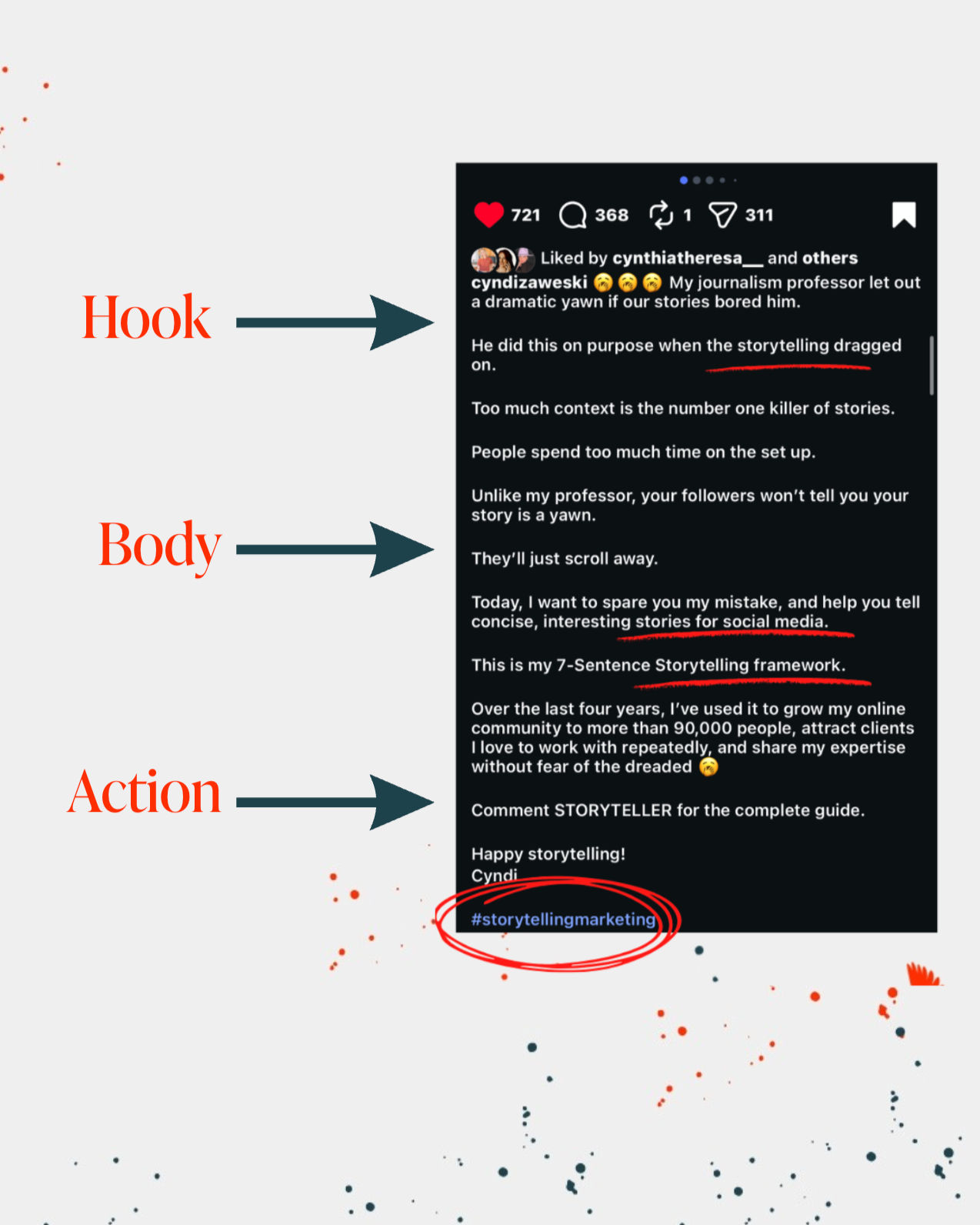
The structure of a good Instagram caption is a three-parter:
The Hook: The first 10 to 12 words before the ‘read more’ button. Below I’ll show you how to write IG caption hooks in a limited character count.
The Body: This is the context for the visual aspect of your post. Here you say why what you’re talking about matters. I’ll show you how to do this with storytelling, since micro storytelling is the top performing Instagram caption style in 2026. Plus, where to add those keywords.
The Call To Action: AKA the CTA where you invite people to take the next step. I’ll show you below how to write CTAs for saves, shares, and (my personal favorite) newsletter signups.
Hooks For Instagram Captions
I think me, you, and your audience can agree: All the marketing on social media is exhausting. We can all spot a "How-to" or a "3 Tips" hook from a mile away, and lately, more people are skipping right over any formulaic Instagram caption copy.
In 2026, tapping that “Read More” button feels like a major commitment for an audience that is already busy and inundated with content. On Instagram, you have roughly 80 characters (about 10–12 words) to convince someone that clicking “more” is worth their time.
If those 80 characters are obviously written by AI, or if they’re just a generic summary of what the visual aspect of the post is already showing them, could you really blame people for not wanting to go further?
To get them to click "more," you have to break their expectations in the first 80 characters.
3 Best Instagram Caption Hook Writing Practices
1. Expand on the Visual (Don't Just Describe It): If your Reel shows you drinking coffee, your audience already sees that—you don’t need to tell them. Instead of starting with "Drinking my morning coffee," use those first 10 words to give them the "inside scoop." Tell them what you were thinking in that moment, the big realization you had over that latte, or why that coffee was the only thing keeping you sane that morning.
2. Lead with the Tension: The best hooks start in the middle of a thought or a story. Instead of a formal announcement like "I have a new program," try something that creates a little curiosity, like: "The moment I realized my old strategy was finally failing me..."
Here are a few head tilting curiosity inducing caption hooks that always work:
The "Conflict" Hook Example: Start in the middle of the mess.
Instead of: "I had a difficult client..."
Try: "I was 5 minutes away from firing my biggest client."
The Number Hook Example: Psychologically speaking, numbers that offer context interest people.
Instead of: Follower count doesn’t matter
Try: “I have 65,000 followers, but I’d trade 60,000 of them for 100 more people on my email list.”
The "Confessional" Hook Example: Vulnerability is the only thing AI can't fake.
Instead of: "Why you should start a newsletter."
Try: "I woke up to 0 followers and a 'Disabled' message on my IG screen. In 60 seconds, my entire business vanished."
3. The Transformation Hook: I call this headline writing style “Two Sentence Storytelling” because it has everything you need to set up an engaging story for Instagram: The Before and The After. By leading with the beginning and ending point of the transformation, you’re hinting that there is much more to the story, which compels people to dive into the caption to find out what happened for that shift to occur. This positions you as someone with personal experience worth listening to. In this case, it’s relatable but authoritative. If a reader is feeling conflicted about something—like aging or burnout—you’ve just told them you’ve already navigated it and come out on the other side. It’s a trust-builder.
Transformational Hook Example: "At 18, I thought going to bed at 9 p.m. was a sign you gave up on life. At 38, I wondered what took me so long."
The "Read More" button is a transaction. The user is paying you with their attention. If your first line is "Hey everyone!" you’ve already defaulted on the loan.
You must give them a reason to believe the next paragraph contains a secret, a solution, or a story they haven't heard before.
IG Captions Copy Tip: If you're not sure, try the "So What?" Test. Read your hook out loud; if the response is "So what?", you need to add more stakes or a clearer benefit.
The Body An IG Caption Is For Storytelling
Now that they’ve clicked "Read More," your the body of your caption needs to keep them there. People naturally love to know the “why” behind things, and there is no more engaging way to explain why then through storytelling.Yes, I am a storyteller and my brand is StoryCraft, so I am bias. But I am bias because it works. The data backs me up:
Platform heatmaps show that users spend 40% more time on posts that use first-person sensory language compared to "how-to" lists.
According to recent 2026 consumer reports, 72% of Gen Z and Millennial users say they intentionally skip AI-generated captions. They want the real story.
Posts with personal anecdote to a call-to-action (CTA) see a 3x higher click-through rate than posts that go straight to the pitch!
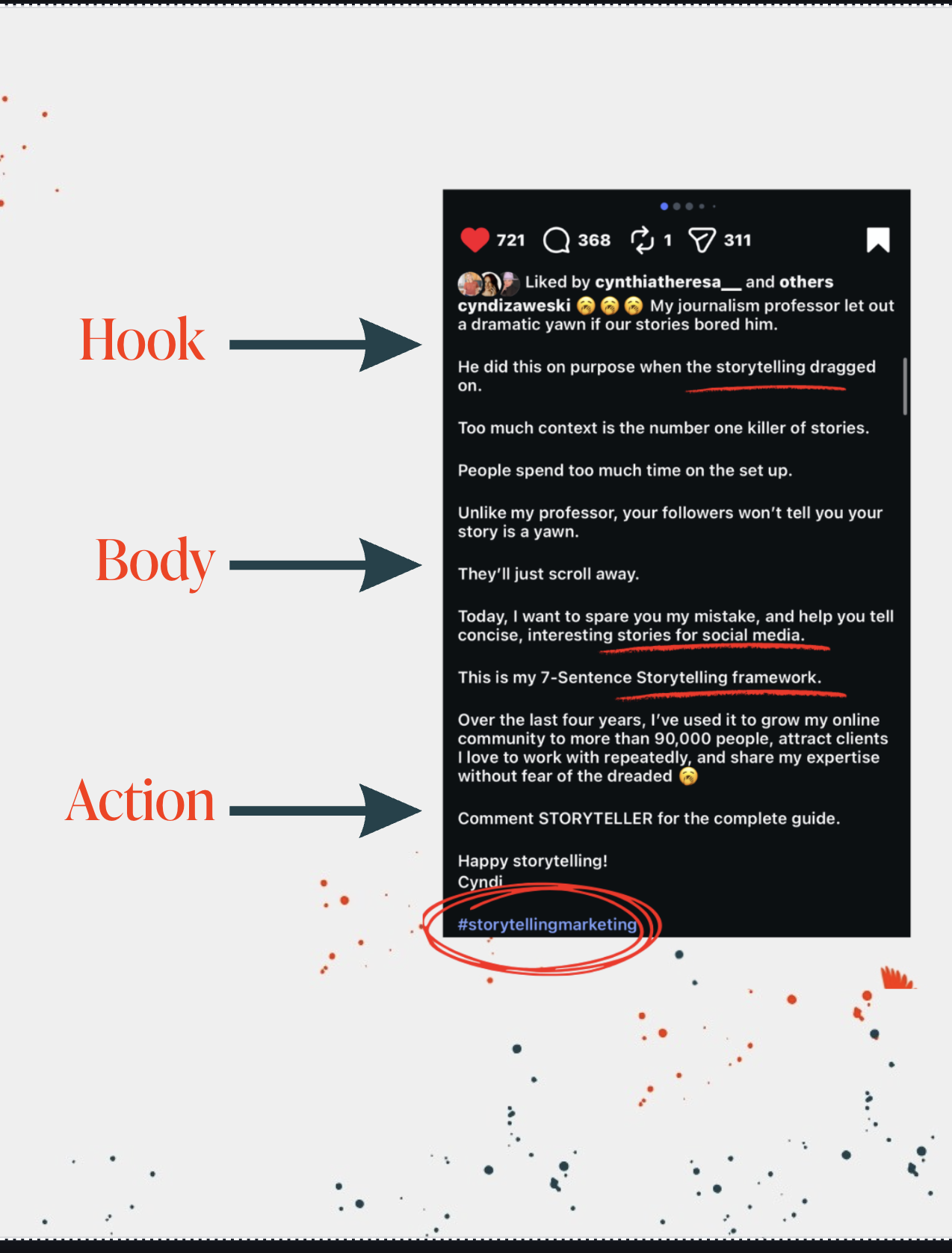
Here is an example of micro storytelling in Instagram captions that weaves in Instagram SEO and keywords.
A lot of what we teach as subject matter experts is abstract.
Terms like "conversion rates" or "heart-centered" don't actually mean anything to someone who hasn’t experienced it. If your audience has to work too hard to understand what your talking about or why it matters to them, they’ll just keep scrolling because decoding it takes too much mental energy. That’s why we use story to explain.
In my example caption, I didn’t want to say too much context is boring. Because if you’re not in the content world terms like “context” are abstract. I needed readers to get the importance of being concise, while acknowledging that it isn’t always easy and I had to learn the hard way.
This short storytelling caption gave context to the corresponding IG cover slide headline which said: “Master Storytelling in 7 Sentences.”
The slides gave them my viral 7 Sentence Storytelling Framework, and the caption told them why using the frameworks matters to them.
Stories create understanding, an understanding creates trust.
So by the time they get to the end of your caption, they don’t just get the message—they believe it and you.
Okay, it’s your turn. Grab my free micro storytelling guide for a tried-and-tested 15-minute storytelling content creation process to write your own storytelling captions, carousels, and newsletters. (7 Sentence Storytelling Guide included.)

Keywords In Instagram Captions
We can’t end this conversation about the body of IG captions without talking about how to add keywords to increase reach and look term discoverability.
Look at how the keywords are "peppered" throughout:
"He did this on purpose when the storytelling dragged on."
"I want to spare you my mistake, and help you tell concise, interesting stories for social media."
"This is my 7-Sentence Storytelling framework."
Notice that I didn't just repeat one word. I used a cluster of related terms: storytelling, stories for social media, storytelling framework, and storytelling marketing. In 2026, the algorithm doesn't just count how many times you say a word; it looks for Semantic Mapping— aka using various words that relate to the topic. This demonstrates niche authority.
Instagram Caption Hashtags Guide
Instagram has officially capped the effectiveness of hashtags. Using 3 to 5 highly specific tags (e.g., #NashvillePotteryStudio) acts as a filing label for the algorithm.
Anything more is flagged as "keyword stuffing" and can suppress your post.
Writing CTAs For Instagram Captions
Next, we’re gonna talk about how to encourage people to take the next step after the read your caption. Earlier, I mentioned that Shareability is the ultimate green flag for the 2026 algorithm—it’s the proof that your content hit an emotional chord so deep that someone else had to pass it on. And I’m going to give you examples of what to write in your CTAs to increase shares.
But: You aren’t on Instagram to serve Instagram.
As fewer people spend time on social media, the ultimate way to build a sustainable brand is to move those emotionally invested readers into your own ecosystem. So we’re also going to talk about caption CTAs to increase newsletter signups. I’m not just saying this because it’s a marketing best practice. I’m saying it because it’s how I protected my business. In 2025, I decided to take an Instagram break. As of today, April 3, 2026, it’s been a four-month break from posting on Instagram entirely.
Even though I’m on the app, my sales increased by 176% since I stopped posting October.
How? Because I didn’t just have followers—I had access to my audience through an email list I owned. I spent the months prior to my break using my Instagram captions a way to build my email list. By the time I stepped away, my community already said yes to having me into inbox. A big reason I talk about how to use Instagram is so you don’t have to rely on it.
CTAs For More Shares on Instagram
People don't share tips—they share perspectives and emotions. When shares, they are saying, "This is so me" or "My audience needs to hear this."
Your CTA is the last bit of encourage they need to hit that paper plane icon and send your post off into their world.
1. The "Call Out" Share
To get more shares, your CTA shouldn't be a generic "pass this on." It should identify the exact person or situation the story was written for.
Fitness Coach Example:"Send this to the friend who thinks they have to do 2 hours of cardio to see results."
Home Organizer Example:"Pass this on to the mom who is currently drowning in a 'junk drawer' that has taken over her entire kitchen. "
2. The "Line in the Sand" Share
Use this when you’ve taken a stance against a common industry lie or a status quo that isn't working for your clients.
Fitness Coach Example:"Share this to your Stories if you’re not buying into diet culture anymore.
Home Organizer Example:"Share this if you feel like no one else in your house helps you clean and your sick of being the only one who does.
CTAs That Increase Newsletter Sign Ups
This is the move that builds a business that outlast the 24 hour lifespan of most Instagram posts.
The goal here is to make the signup feel like a massive upgrade.
You’re inviting them into a space where you share wisdom, data, and unfiltered perspective they don't hear from you on the app.
The Freebie CTA: I love using automations like Manychat for newsletter CTAs so people don’t have to take the extra step of clicking over to your bio, they can simply comment a keyword to get your freebie or sign up link straight to their DMs.
Example: "I’ve built a Recovery Audit that helps you identify exactly which part of your routine is holding you back—it's the same data I use with my 1-on-1 clients. Comment REST and I'll drop the link in your DMs so you can join my email list and get the audit for free."
If You Have A Nuanced Point of View: This shows people your expertise is more than Instagram character count deep. Long form content builds trust. Use this for ideas that are too complex or controversial for a public feed.
Expert Example: "Instagram is great for the 'After' photo, but it’s terrible for the psychological hurdles that happen in the middle of a declutter. I’m sharing the specific Decision Framework I use to help clients move past the guilt of letting go—things the caption can’t hold—in this Tuesday’s email. Join the list to see what really happens behind the scenes."
Best Instagram Caption Practices
We’ve talked about the "Why" and the "How," but we can’t ignore reader experience from a visual standpoint.
The optimal caption length debate has raged on for years, but in 2026, the data shows that length doesn't matter—depth and scannability do.
Whether your caption is 20 words or 2,000, use these formatting guardrails to ensure your message is easy to absorb:
White Space is Your Best Friend: Use frequent line breaks. White space allows the reader's eye to rest and helps them digest one thought before moving to the next.
The "Skim" Test: A reader should be able to skim your caption and still walk away with a better understanding of why your topic matters to them. Use bullet points for lists, ALL CAPS words strategically, and emojis as visual-rich punctuation.
Strategic Emojis: Speaking of emojis, they’re like digital body language—helping you communicate emotions and your brand voice when words don’t quiet capture the mood. Recent data shows that adding emojis can significantly increase engagement. Just be careful not to overdo it! Every emoji should have a purpose.
How To Write Captions That Create A Cohesive Brand Narrative
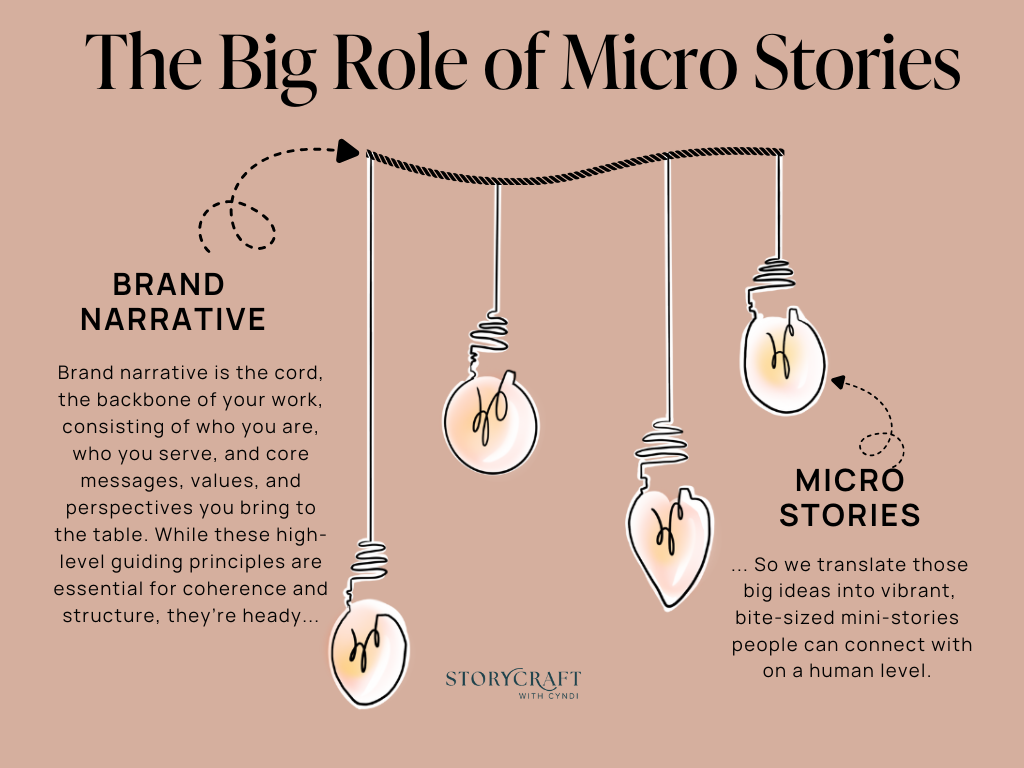
If you have you ever wondered: Do people actually read the captions? By now, you know the ones who care about what you have to say do.
A
nd when you use storytelling to explain why what you’re talking about matters to them, they’ll take the next step. But spending time writing captions isn’t just a one-off win. Every intentional storytelling caption you write is building a larger Brand Narrative that people remember long after you’ve posted.
Every caption you write is a lightbulb.
These mini stories are what translate your big, high-level ideas into vibrant, bite-sized moments that people can connect with on a human level.
Building a brand narrative strategy doesn't have to be overwhelming.
It’s actually just a series of small, intentional choices in how you share your messages, values, and offers with the world.
But I know that sometimes, staring at a blank screen is the hardest part of the job.
That’s why I want to give you my Micro-Storytelling Guide for free.Inside, I’m break down the exact 7-sentence framework I use to explain abstract ideas through stories that build massive trust. It’s the cheat sheet you need to make sure every post you share isn't a random act of content—it’s a lightbulb that makes your entire brand shine.
Thanks for Reading!

Cyndi Zaweski, Owner of StoryCraft
Cyndi Zaweski is an independent journalist and the owner of StoryCraft. She writes primarily about how narrative influences behavior, exploring how storytelling, belief, and perspective drive action through the lenses of marketing, philosophy, psychology, technology, spirituality, and beyond. Her brand story clients have been featured on CBC, iHeartRadio, The Minimalist Podcast, and more.
Instagram Caption Writing FAQs
-
There isn't a single perfect length for an Instagram caption, as the ideal word count depends entirely on your goals. The optimal caption length debate has raged on for years, but in 2026, the data shows that length doesn't matter—depth and scannability do.
-
Yes. Since the 2025 integration, professional Instagram account content is indexed by Google. This means your captions act as mini-blog posts. By using searchable keywords and structured storytelling, your Instagram posts can drive traffic to your brand months or even years after the initial post date.
-
Yes, but their role has fundamentally shifted. In 2026, hashtags are no longer a reach engine used to go viral; they are now a categorization tool used to help Instagram’s AI understand exactly what your content is about.
If you are still using 30 hashtags per post, you’re likely hurting your performance more than helping it.
The 2026 algorithm prioritizes keywords woven naturally into the caption over long strings of hashtags.
For best results, use 3 to 5 highly specific hashtags at the end of your post to help the algorithm categorize your content without triggering keyword stuffing penalties.
-
Dwell time is the amount of time a user spends viewing your post with their thumb off the screen.
Because Instagram functions as a visual search engine in 2026, high dwell time signals to the algorithm that your content is valuable.
Micro-Storytelling"captions are the most effective way to increase dwell time and boost your post's ranking in search results.
-
An effective 2026 caption hook must be under 80 characters (roughly 10–12 words) before the "Read More" button.
To get people to read your captions, avoid "AI-sounding" intros. Instead, use Tension-Based Hooks (starting in the middle of a conflict) or Transformation Hooks (contrasting a "before" and "after" state) to create curiosity.
