3 Steps To Engaging Storytelling Content Creation (With A Story Bank And Storytelling Templates)
Updated: April 2026
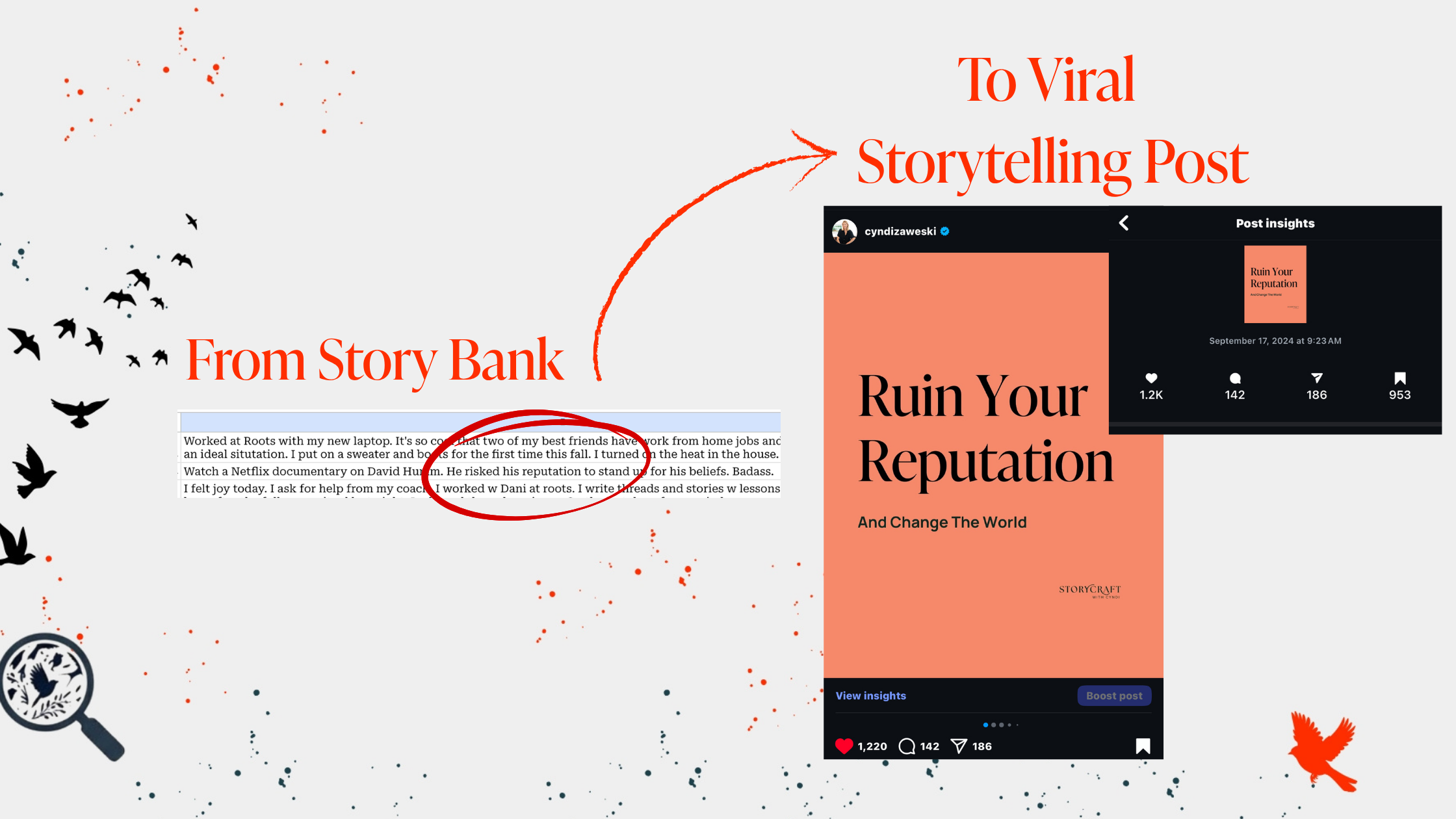
How To Create Storytelling Content
Think storytelling content will take too long to create?
Ok, yes, it’s not as fast as ChatGPT.
But while posting AI-generated content can actually damage your reputation, storytelling makes you more trustworthy.
Let’s talk about how to create engaging storytelling content with a reliable system that takes 5-15 minutes a day and compounds into a respectable brand narrative.
Storytelling For Content Creators
Last Saturday, I got a DM from a woman who’s been in my community for years. Let’s call her Sarah.
Sarah wants storytelling content that showcases her valuable work while building stronger connections with her audience. The problem, she said:
“I end up going back to [sharing] tips and hacks. I’m guessing I need to build a better storytelling practice?”
She's right oh so right.
A consistent storytelling practice makes it easier to write content that builds trust, fires up engagement, and makes your expertise clear.
But let’s acknowledge the elephant in the room:
Storytelling content is harder than busting out plain ol’ “tips and tricks."
You’re an expert, so you can do “X Ways To Do Y — Without Pain Point” posts in your sleep.
But storytelling requires reflection and connecting the dots—things that don’t come always at lightning speed.
Most people take the “just do it” approach. They sit at their screen and try to tell a story from scratch.
And it almost always ends, as Sarah described, with wasted time and inconsistency.
The good news: Writing stories that illustrate your expertise and personality doesn't have to be a time suck once you have a process.
I told Sarah I’d share my system to help her build a storytelling practice that’s easy to stick to in last week's StoryCraft newsletter.
I’m re-sharing here, including with my three steps to creating micro storytelling content for Carousels, captions, and newsletters.
Let's dive in.
Storytelling In Content Creation Step #1: A Story Bank
Coming up with relevant and relatable story ideas can be the hardest part about writing micro stories that build a brand narrative. Instead of giving yourself the Herculean task of figuring out what story to tell, how it's relevant, and how to write it all at once, make it an easier lift by storing inspiration in a story bank.
There’s is a full story bank template and guide inside my storytelling course, but if you’re scrappy and have extra time (you, unicorn, you!), you can 100% build this on your own.
Open up a Google Spreadsheet
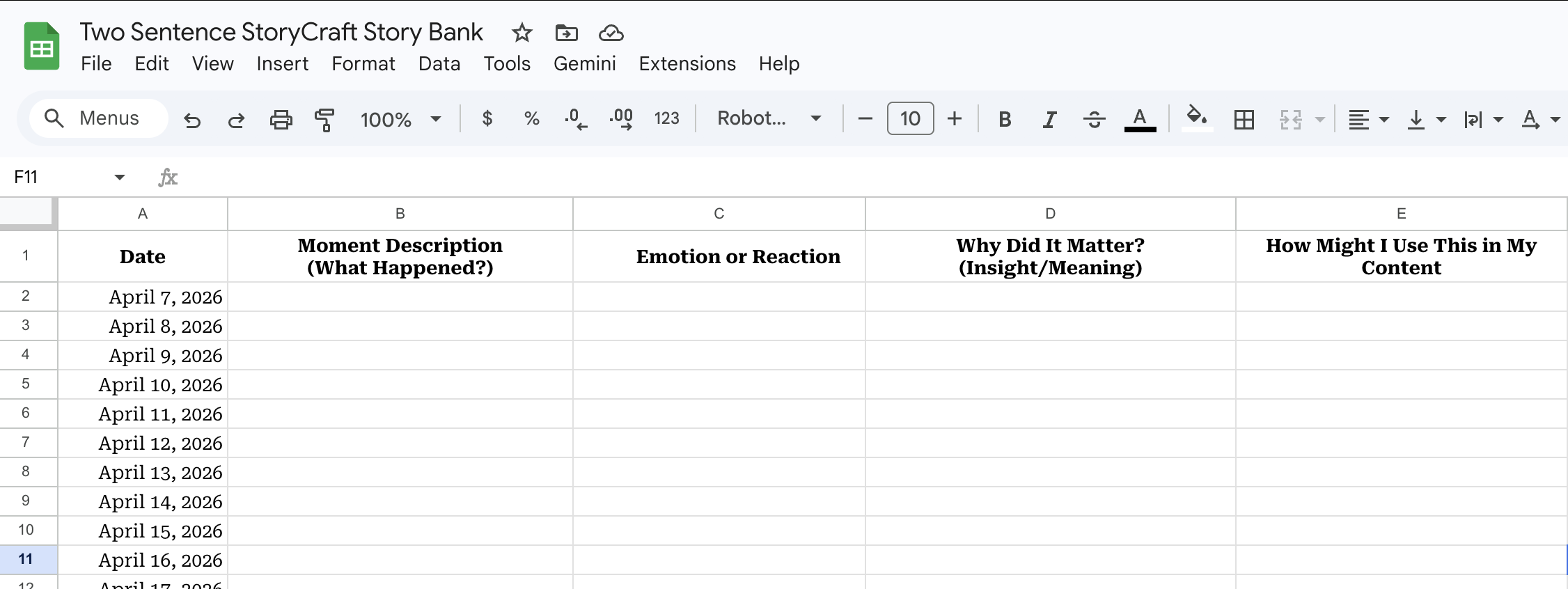
Add five columns across the top:
Date
The Moment
Emotional or Behavior Reaction
Why Did It Matter?
How Might You Include It In Content?
My Story Bank template looks like this:
3. Add story-worthy moments and fill in each row.
This daily process takes about five-minutes.
The goal is to leave yourself little notes that help you remember the moment and the lesson it shares.
Carve out five minutes a day (or week if that’s more manageable to start), preferably at the same time so you make it an automatic storytelling habit, to write down your story-worthy moment of the day.
What is a story-worthy moment?
A story-worthy moment is a small, seemingly ordinary, and often fleeting 5-second experience of realization or transformation that, when told, connects deeply with an audience. Popularized by award-winning storyteller Matthew Dicks, these moments don't need to be dramatic, but they must represent a change in thought, emotion, or self-perspective.
Once you have the moment in mind, jot down two sentences.
What triggered the moment? What were you doing, thinking, feeling?
What happened as a consequence? What did you realize? How did your thoughts, behavior, or believes change?
That’s it. A simple before and after.
Change is the foundation of all stories, and when there’s an emotional shift and consequence as a result of that change, you know you have a good story.
I break this down how to turn a moment into a micro story for your Instagram Carousels, captions, and newsletters inside my storytelling course.
But all you need to know to start is this two-sentence process.
Story Ideas For Your Story Bank
At this point you may be thinking: Cyndi, my emotions change approximately a zillion times a day, how do I know which moment is best for my story bank?
Over the last six years, I’ve had hundreds of viral storytelling Instagram posts and storytelling newsletters that sold my offers and courses.
Some stories just work better than others to share your message, values, and offers—and I’ve noticed the pattern.
Here are the types of stories to include in a story bank that your audience will love hearing from you:
Story Bank Idea #1: Observations

A secret to creating relatable storytelling content is saying what others are thinking. This is a natural byproduct of slowing down and noticing what you notice, which will become second nature with your story bank practice.
This micro story example came from a a local coffee shop.
I learned the lesson, "When You Keep Showing Up People Notice. But You Have To Show Up For Yourself First," when a barista came over after five weeks of seeing me at the same table, doing the same work. She told me my consistency was inspiring and gave me a coffee on the house.
When people sense the emotion in your message, they feel it too.
And stop to read it.
Perhaps like you, my community on Instagram is exhausted by the hustle culture of showing up for the algorithm, for the likes, and for the strangers.
This micro story moment pivoted that expectation—stating that the real power comes from showing up for yourself first. It wasn't just a clever hook. It was an unspoken truth that they felt in their bones but hadn't given themselves permission to voice.
All good storytelling is about articulating change, emotion, and meaning.
I mentally note the little moments that light me up and think about why they had an impact.
I question the cause behind that emotional shifts and reactionary behaviors in my day. In this case, I realized the barista only noticed me because I had already spent five weeks showing up for myself before anyone else was watching. By noticing how my emotions and behavior shifted, I caught a deeper value of mine in action: Sustainable productivity.
This is a mini narrative people feel in their bones because it isn't a "hot take" for the sake of going viral. It’s an original, memorable brand message that only came because I was willing to slow down enough to hear myself.
Story Bank Idea #2: Conversations
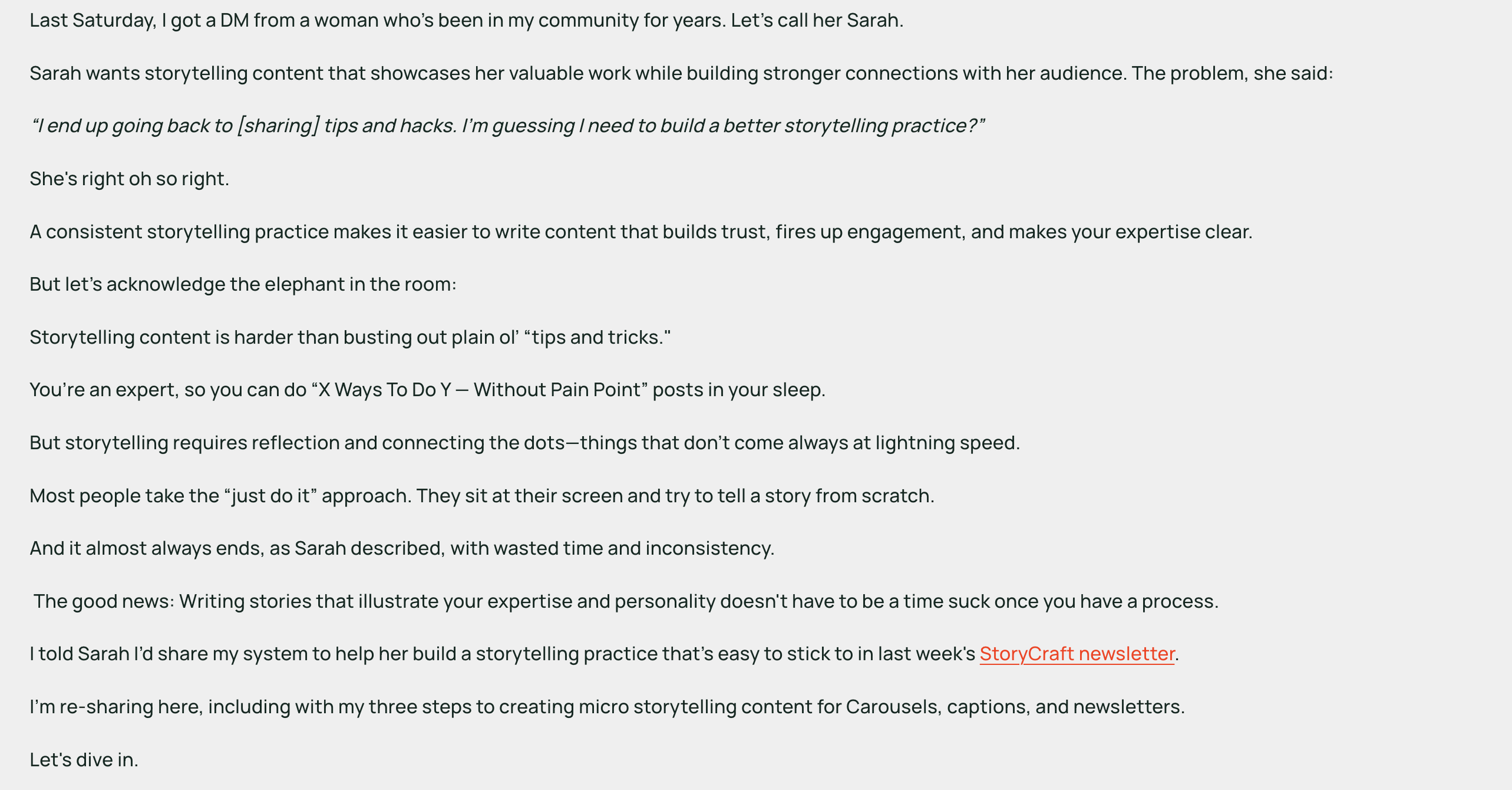
Conversations with friends, clients, in the comment section, DMs, or the grocery store are all great inspiration for story ideas. Dialogue is always a strong storytelling hook because it brings people right into the action.
Simply letting people in on a conversation you had about a relevant problem is often a valuable story in and of itself. (Like I did at the top of this blog ).
Story Bank Idea #3: Storytelling With Data, Studies, And Articles

Research, studies, or data for storytelling lends credibility and context to your ideas. This is important because:
When people don't understand the context it weakens your point of view. Backing your perspective up with numbers demonstrates your professional opinion is not some “hot take” for likes sake but rather a trustworthy interpretation facts that provides the gift of clearer understanding—a huge value add for a busy audience.
Here’s a storytelling with data example from recent StoryCraft blog about why and how to market your business without social media in 2026.
Story Bank Idea #4: Other People’s Stories
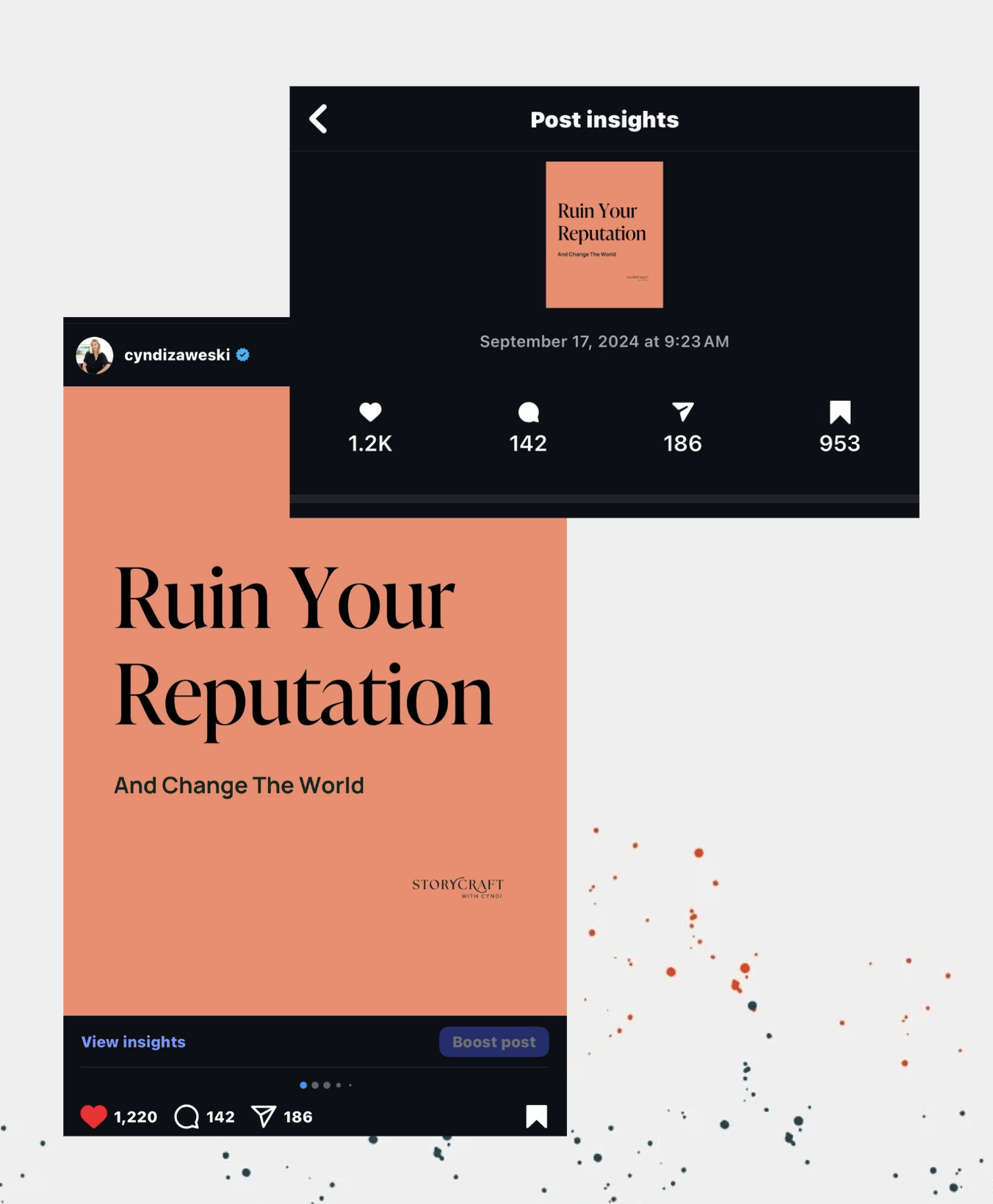
If you’re an introverted entrepreneur or you’re just not ready to share your story yet, you can still create storytelling content. Using other people’s story to share your brand message is an underrated way to use storytelling in content creation because they’re both interesting and relevant.
The inspiration for this storytelling carousel came on a lazy Sunday afternoon watching Netflix. I remember looking up from my phone in awe to refocus on watching the documentary You Are What You Eat, where Daniel Humm—the chef behind NYC’s Eleven Madison Park—discussed his bold move to completely overhaul the famed Michelin-starred restaurant’s menu.
His values had changed, and from then on, he would only serve a 100% plant-based menu.The backlash was swift.
The New York Times bashed the decision in an article tarring Humm’s exceptional reputation. He didn’t back down. Eleven Madison Park went on to earn another Michelin star, changing the expectation of fine dining in the process.
This story works so well for the StoryCraft brand because it speaks to using your brand message and story to stand up for what you believe in—even when it’s not popular. My followers resonated, and the post went on to reach 23,000 people in 24 hours. I later repurposed this story for a newsletter.
I pulled this idea out of my story bank months after I first noted it and it continues to be one of those micro stories I tell over and over again, all thanks to an otherwise boring Sunday watching TV.
Story Bank Idea #5: Something You Read, Heard on a Podcast, Saw on Your Favorite HGTV Show

Your story-worthy moments don’t have to be as dramatic as Humm’s tale of rebellion. Honestly, some of the best micro-storytelling moments are tiny reflections on what you’ve read, heard, or watched. The key is to use your personal experience to tie what you’ve heard to a brand value, a core message, or even an offer.
Over the fall, I shared a snippet from my "get it done" workcation.
On the surface, it looks like a simple Instagram story with a behind-the-scenes snapshot. But if you look closer, it’s actually a micro-story built around my brand value of showing up for yourself—even though I never say those exact words.
What I love about these types of micro-stories is that you can find them anywhere. Anytime you read, listen, or watch something and it makes you go “hell yes,” “hell no,” or even just “huh,” it’s a sign to put it in your story bank.
Storytelling In Content Creation Step #2: Word Vomit
The point here is to get clear on what you’re going to write. Once you’ve pulled a seed from your story bank, the worst thing you can do is try to make it polished right out of the gate. That’s how perfectionism kills your story before it's posted.
Instead, I want you to just word vomit the details onto the page—beginning, middle, end and lesson. Don't worry about the hook, the CTA, or even the grammar during this stage of the storytelling content creation process. Often overthinking is the biggest barrier to telling stories.I encourage you to challenge yourself do this free writing in 10 minutes, or less.
Just get the raw details of the transformation down, keeping this question in mind: What is the one thing you want the reader to feel and remember?
You aren't trying to win a Pulitzer; you're just trying to find the emotional backbone of the story along the details that bring your brand message to life.
If you try to edit while you write, you’ll lose the "hell yes" energy that made you capture the idea in the first place. You can’t refine the rhythm of a story until the words actually exist, so let them be messy. We’ll structure your story and polish your prose in the next step—for now, just get the heart of the message out of your head and onto the page.
Storytelling In Content Creation Step #3: Storytelling Templates
Now that you have it all on the page, it’s time to give your story structure so your point is clear and only interesting details that drive the narrative forward remain.
This is where most content creators get stuck—they have the raw ingredients, but they don't know how to cook the meal.
That’s why I recommend storytelling templates for this stage of the content creation process.
A storytelling template is the strategic narrative structure that ensures you have the right amount of detail, that you’re using emotional words that show don't tell, and that the transformation you’ve captured in your story bank clearly explains the relevance of a brand message, value, or offer.
Think of storytelling frameworks as training wheels: use them to guide your storytelling in content creation until you’re steady enough to do it all on your own. Eventually, you won’t even need to reference a template; you’ll have an intrinsic feel for the rhythm of a good story. But until then, they keep you from rambling or losing your audience’s interest.
storytelling structure template
I use storytelling templates to make writing the finished post or newsletter faster.
The framework I use depends on the goal of the story — but all brand stories should check these boxes.
Is there a clear transformation?
Is it easy to understand why this matters to the reader?
Does it offer a takeaway, lesson or insight that helps my audience and shows them who I am?
This checklist makes ensures my stories are always relevant, helpful, and not boring.
Become A Story Telling Content Creator
Including storytelling in content doesn’t have to take more time than the posts you’re pouring into now.
With a 5-minute storytelling collection habit that builds a rich bank of ideas, a 10-minute freewriting session that gets it all onto the page, and storytelling templates that guide you on how to give coherent structure to that word vomit, you’ll have original, personality-packed storytelling content ready to post in less time than it takes to get DoorDash.
To make this process faster and more likely to result in storytelling content you’re proud to share, I want to leave you with my viral 7-Sentence Storytelling Template for social media posts an newsletters. It’s inside my free Micro Storytelling Guide, where you’ll learn how to turn a personal experience into an engaging piece of storytelling content in 15-minutes.

Thanks for Reading!

Cyndi Zaweski, Owner of StoryCraft
Cyndi Zaweski is an award-winning journalist turned brand narrative strategist. Through storytelling coaching and narrative strategy, she helps experts build a cohesive brand and body of work so they’re remembered for what they say—not how often they post.
Storytelling Content Creation FAQs
-
A story bank is a digital library where you proactively collect anecdotes, lessons, aha moments, and behind-the-scenes learnings. The benefit of a story bank is to make content creation and storytelling easier and faster. Instead of staring at a blinking cursor on a Tuesday morning, you go to your bank and withdraw a story that’s already half-written so you can easily create storytelling content.
-
A storytelling template is a strategic structure for storytelling content that organizes the key moments of a narrative into a logical flow with an emotional backbone. Most brand stories are just diary entries—they have a beginning and an end, but no transformation. A storytelling template guides you to identify the transformation: the emotional heart of the narrative that is responsible for sales, engagement, and brand message recall.
Templates are like training wheels: use them to guide your storytelling in content creation until you’re steady enough to do it all on your own. Eventually, you won't need to look at the story frameworks—you'll have an intrinsic feel for the rhythm of a good story. But until then, they keep you from rambling or losing your audience's interest.
-
A story-worthy moment is a small, seemingly ordinary, and often fleeting 5-second experience of realization or transformation that, when told, connects deeply with an audience. Popularized by award-winning storyteller Matthew Dicks, these moments don't need to be dramatic, but they must represent a change in thought, emotion, or self-perspective.
-
Beyond engagement, storytelling drives conversions by bypassing the logical brain and speaking directly to emotions. By framing a product or service within a Conflict-Resolution narrative, creators move the audience from passive observer to active participant. When people see themselves in the stories, it often results in a 20% higher conversion rate on landing pages.
-
StoryCraft’s 7-Sentence Framework helps creators simplify the process of storytelling content creation. By breaking a narrative down into seven specific beats—from context to resolution—this framework ensures that even new creators can produce structured, high-impact stories that resonate with their audience.
StoryCraft’s 7-Sentence Framework:
1 Sentence for Context (Who/What/Where).
2 Sentences for the Problem (The Conflict).
2 Sentences for the Response (The Action).
1 Sentence for the Result (The Outcome).
1 Sentence for the Lesson (The Value).
Thousands of business owners have used this storytelling for content creators template to go viral and build their community—even if they’ve never today a story before.
Get your free 7-Sentence Framework template with examples here.
-
In 2026, search engines and AI chat bots prioritize EEAT (Experience, Expertise, Authoritativeness, and Trust). Sharing personal anecdotes, failures, and unique case studies provides the Experience factor that AI cannot replicate, leading to higher rankings and 22x better audience retention.
-
To create SEO-friendly storytelling content, follow the Hook-Context-Insight framework:
The Hook: Use a bold statement or question in your H1 to stop the scroll.
The Context: Use "I" and "We" statements to establish first-hand experience (vital for 2026 SEO).
The Insight: Connect the story to a high-volume keyword like "storytelling in content creation."
The Schema: Use FAQ schema markup to help AI assistants pull your story as a direct answer.