
How to Post Less and Reach More With a Storytelling Marketing Strategy for Instagram
Updated: April 2026

Why A Storytelling Marketing Strategy for Instagram Lets You Post Less And Reach More
Strategic storytelling is for entrepreneurs who want the freedom to post less while getting results from their Instagram marketing.
The numbers are in, and they confirm what we’ve felt in our bones: The 'more is more' era of social media is dead.
In 2025, Instagram engagement dropped—again. This time by 26% as content fatigue hit an all-time high. So if your Instagram reach is down, it’s not your content that got worse. It’s the platform that did. With 50% of Americans now intentionally limiting social media to avoid attention-stealing content with no depth, the traditional 'post every day' Instagram strategy is, frankly, a recipe for doing more and getting less.
Call it the slow marketing marketing, but posting less is yielding better marketing results across social media.
Just this year, Linkedin published an engagement report that would have shocked digital marketers in 2022.
It says: LinkedIn’s algorithm now favors high-quality, engaging content over high-volume posting, meaning you can increase visibility by posting less.
Which begs the question: What is considered high-quality, engaging content in 2026? Turns out, there’s data for that too.
Because wide spread AI-generated content, people are sick of more information; they’re look for meaning.
They’re looking for experts like you to make sense of and provide solutions to their problems based on your personal and professional experience.
This is why a storytelling marketing strategy is so effective. Strategic storytelling content is 22 times more memorable than the regular content you’re pouring into now—so you can post less and stay top-of-mind.
Storytelling marketing strategy for Instagram is ultimately about gaining the freedom that comes when you’re remember for what you say not because of how often you post.
In this article, I’ll break down the exact strategy for Instagram that allows me to post just three meaningful pieces of storytelling content per week that have been seen by more than 800,000 Instagram users who are interested in my message. Here is my storytelling content creation plan to post less and reach more.
Storytelling Marketing Example Of The ‘Post Less’ Approach

“I feel like I’m constantly on my phone — posting, checking notifications, closing the app, immediately reopening it, checking again.”
One of my storytelling coaching clients recently described the “always on” trap that depletes business owners trying to grow.
It gave me flashbacks to this time last year, careening full speed ahead toward a burnout that took eight months to recover from.
Back then, I didn't see the signs. I just knew I’d lost my creative edge. But I forced myself to keep feeding the algorithm five days a week, constantly checking for external validation to remedy the fact that I was disconnected from my work.
Eventually, I fizzled out and went completely dark for three months. I didn’t know if I’d ever return to my 55,000 followers. But in that silence, I realized I still had a message—I just needed a storytelling strategy that didn't burn me alive.
I designed a strategic storytelling Instagram strategy that allows me to post less and communicate my message intentionally.
The results? My content has received more than 800,000 views in the last three months while posting only three times a week.
Most importantly, I am well. I’m energized. My instagram storytelling strategy doesn’t eat of my time demanding I create more, it gives me the time to create intentionally. Whether social media is stealing your time or chasing metrics has you on the edge of burnout, this approach will help you be efficient so you can show up consistently without being “on” constantly.
How To Start A Storytelling Marketing Strategy For Instagram
All good strategy starts with an insight. And a brand narrative strategy is no different.
Strategic insight is simply an 'Aha! moment' where data meets human behavior.
Practically, it usually starts an observation backed by evidence (studies, metrics, data) that gives you clear direction on what to say and how to say it.
This is the insight I based my strategy on when I returned from my Instagram break in 2024. Funny enough, it came from my journalism days, not my digital marketing background.
It was this truth:
The best way to make a brand message clear, engaging, and relevant is to explain it through storytelling content.
The numbers backed me up:
Storytelling is 22x more memorable than the content you’re pouring into now
Content with storytelling receives 300% more engagement
Storytelling can increase conversions by up to 30%
I began with a four day a week posting schedule. I did not learn my lesson.
Even four times a week was too much as I was recovering from burnout as a content creator, plus social media isn’t my primary focus anymore.
At the time, I was winding down my content agency to go full time as a writer, narrative strategist, and storytelling coach. Spending too much time designing Instagram posts holds little appeal.
But something good did come out of that short-lived, four-day-a-week posting schedule:
The insight got me the results I mentioned at the beginning. My engagement spiked — higher than before I took a break from Instagram — when I created Instagram Carousels and static posts with storytelling.
I realized I could post less and still make my point stick.
And in that moment the new storytelling strategy for Instagram was born:
Storytelling content. Three times a week. NO reels.
What insight can Guide your storytelling social media strategy?
Let’s think for a minute:
What are the messages people love hearing from you?
What stories is your audience already telling themselves about your industry?
Where does your audience need more understanding so they can really get how you help?
What is the status quo in your industry and how does your approach offer a breath of fresh air?
Tapping into these relevant themes and marrying it with a transformation statement that clearly explains how your work changes lives is the best place to start a narrative strategy, and form the basis of your brand pillars, which are a content structure for sharing your perspectives through storytelling to make your brand message emotionally relevant.
Narrative pillars are core to a cohesive brand on-Instagram and off
But if you just want to start posting less and reaching more, I want to show you what types of storytelling content to make as a content creator.
Instagram Posting Plan To Create Less And Impact More
This is my three-day-a-week Instagram posting plan with storytelling marketing examples.

Brand Context Stories On Mondays
Storytelling content isn’t just individual stories.
In a storytelling strategy, every piece of content builds a bigger picture narrative that gives context to who you are and how you help.
For example, practically is the context for the StoryCraft brand. I don’t want people to think my message is about how great storytelling is for their brand—I want to know StoryCraft is the place for them to learn how to tell stories that work for their brand.
That means my Monday posts are tactical—they provide some storytelling prompt, strategy, or quick win to implement storytelling marketing easily. But we never just want to give tips and tricks. Solid tips and tricks build credibility, but are forgettable without story.
Since you’re posting less, we want every piece to be memorable.
In this post, I marry the tactical with a story about how Steve Jobs wasn’t always a world class storyteller to illustrate my brand message:You don’t have to be a natural born storyteller to tell great stories.
This brand context story memorable for three reasons:
The originality: The Instagram headline breaks the status quo. It’s an idea they haven’t see anywhere else, giving them reason to come back again and again for original takes.
The emotion. I left my readers the warmest feeling of all: Hope. I met them in their frustration ("I’m just not a natural storyteller") and led them to empowerment ("I can learn this, too").
The logic. I teased a taticial tip, my Seven Sentence Storytelling For Social Media Template in the Instagram caption. With a CTA to sign up for my newsletter to get the full framework. A huge factor in using a social media less for the long run, means using Instagram to grow your email list. Make the tips you share on IG the tip of the iceberg to encourage people to sign up for your newsletter or freebie.
For my Monday brand context story post, I put my words where my message is, sharing practical, actionable tips in a Carousel.
In this storytelling example, I share the Steve Jobs story on the slides and the tips in the caption.
The flip works too: Tips on the slide and story in the caption.
You can read the full “Steve Jobs Sucked at Storytelling” Carousel here.
If you want to tell more stories in your content, download my Seven Sentence Storytelling Framework for free here.

Brand Values In Action Stories On Tuesdays
The only way to attract the people who want to work with you because you are you is to show what you makes you different: Your brand values, your vision, and your approach.
Storytelling strategy has nothing to do with how frequently you post on Instagram and everything to do with how you communicate who you are and how you help.
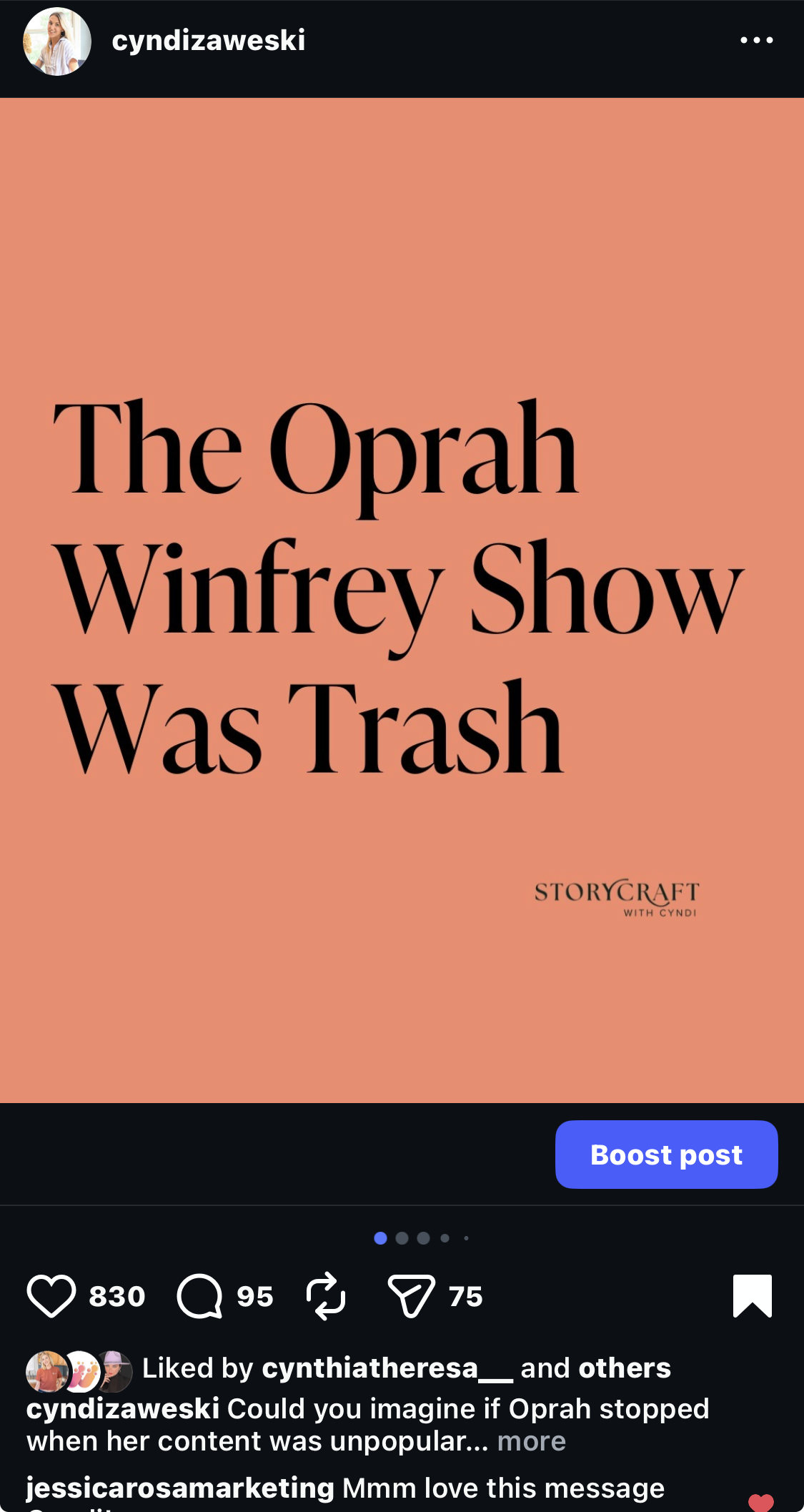
That’s why I tell brand values stories on Tuesday. I’ll admit, this headline “The Oprah Show Was Trash” is pretty jarring. But the bold headline is warranted for the bold story to follow.
This storytelling Carousel post talks about how the Oprah wasn’t always so enlighted. Early episode were more Jerry Springer than Super Soul. But then Oprah had a realization. She wasn’t gonna do that type of content anymore—even if it wasn’t popular.
This micro story works so well for the StoryCraft brand because it speaks to using your brand message and story to stand up for what you believe in—even if it doesn’t get a lot of likes. My followers resonated, and the post went on to reach 17,000 people in 24 hours.
When your audience connects with your values, message, and approach, your offers are a natural next step.
This post sells without selling.
By creating storytelling content around my brand values and unique approach, my business gets client inquiries even tho I hardly talk about the details of my offer on Instagram. The proof is in the P&L: StoryCraft took home $135,600 in 2024—even though I took six months break from 1:1 client work to work on my short-form storytelling course.

Community-Building Storytelling Post On Thursdays
This community-building micro storytelling post took less than 15 minutes to create and reached more than 17,000 people. This post got a lot of shares, comments, and likes while welcoming 118 new Instagram followers. All thanks to one storytelling marketing tactic so few business owners know about: The shared identity narrative technique.
Most marketing seeks to separate: “you” are the expert, “they” are audience.
But communities are built on commonalities.
What do you have in common with your ideal readers?
Think:
Shared goals (i.e. calm minds, financial freedom).
Shared enemies (i.e. anxiety, burnout, perfection).
I sprinkle this storytelling marketing concept everywhere: on the homepage of my website, in my blog, in my newsletters. But on Thursday, I use it to build a community on Instagram.
In this storytelling post, I address an enemy my audience and I struggle with the imposter syndrome-laden thought “I’m not saying anything new.” Believing that our niches are too crowded and everything worth saying on a topic has been said before is so common amount content creators—especially when they spend too much time on Instagram comparing.
Here, I opted for a bold statement on an Instagram graphic with a story in the caption.
But you could also put a relatable storytelling hook on a graphic. It’s a great way to engage people to read Instagram captions.
Here are a couple storytelling hook ideas for ‘post less’ Instagram strategy:
“For 10 Months I Told Myself I’d Go On Camera, Until This One Shift Got Me Do It".” A storytelling hook about overcoming a common enemy is great for community bonding.
A storytelling hook that starts with dialogue is always an attention getter because it brings the reader right into the middle of the action. Start your post with the thought you keep thinking. Like in the caption of this example: “I’m not saying anything new.”
Story Prompts For Instagram Strategy
If you don’t want to burnout, or burnout again, unlearn the force-fed social media narrative that you need to be “on” constantly to stay relevant. Instead just be relevant by strategically creating a brand narrative that pulls the right people into your orbit. Here are your next steps. Draw upon your experience and expertise and riff on these prompts (no self-editing, just flow):
1. Help People Understand Your Brand With Context Stories
Why is your approach needed today because of what’s happening in the world now? What does someone need to know to fully enjoy the benefits of your work? For example, using storytelling to explain the value of your expertise is the best way to be remembered in a 24/7 content world. To fully embrace that fact, everyone needs to know storytelling is a skill they can get better at with intentional practice.
2. Know your values and beliefs, and use them for brand differentiation
Free write 3-to-5 “die-on-hill” viewpoints on what's wrong in your industry—and how to make it right. For example, in my industry (marketing) people are told to post constantly, but because of my experience and client results, it’s my die-on-this-hill belief that we don’t need to post constantly to grow consistently.
3. tap into the shared identity Narrative Technique
“World-building” is a term you're going to here a lot this year. We'll talk about it in the StoryCraft Newsletter, but for now just know: Belonging is the name of the game. Brainstorm on the common enemies I mentioned above, but most importantly, define success. Not just from your offer outcome but how people in your community (including you) feel, act, and embody when life is at its best. Knowing both enemies and aspirations makes it easy to tell transformative stories.
Post Less and Reach More With a Storytelling Marketing Strategy
Creating a life you love with a business that supports it requires showing up in a way that feels good for you.
But that doesn’t mean you have to sacrifice results. A storytelling strategy gives you the best of both worlds.
Before you create a three-day-a-week Instagram posting plan, ask:
Which specific moments from your life and work explain your ideas best?
How do you tell those stories so the people your trying to reach pay attention?
How do you take your big, complex ideas and turn them into small, bite-sized posts that make sense to someone scrolling on their phone?
But once you have those details in place, the execution just fires off.
If you want a partner to turn your ideas and experiences into a cohesive storytelling marketing strategy that gives you back your time, book a storytelling coaching session.
Thanks For Reading!

Cyndi Zaweski, Owner of StoryCraft
Cyndi Zaweski is an independent journalist and the owner of StoryCraft. She writes primarily about how narrative influences behavior, exploring how storytelling, belief, and perspective drive action through the lenses of marketing, philosophy, psychology, technology, spirituality, and beyond. Her brand story clients have been featured on CBC, iHeartRadio, The Minimalist Podcast, and more.
