
How To Write Storytelling Captions For Instagram
Updated: August 2026
Summary: Instagram recently stressed the importance of captions for increasing engagement and improving discoverability. Instagram said the best captions tell a personal story and provide useful information that the audience will want to save or share. The most engaging captions are specific, clear, and centered around a story that offers a point of view that can’t be confused with AI content . In this guide, you’ll be able to turn an oft-overlooked piece of digital real estate into a meaningful act of communication with actionable tips for writing storytelling captions that boost Instagram engagement.
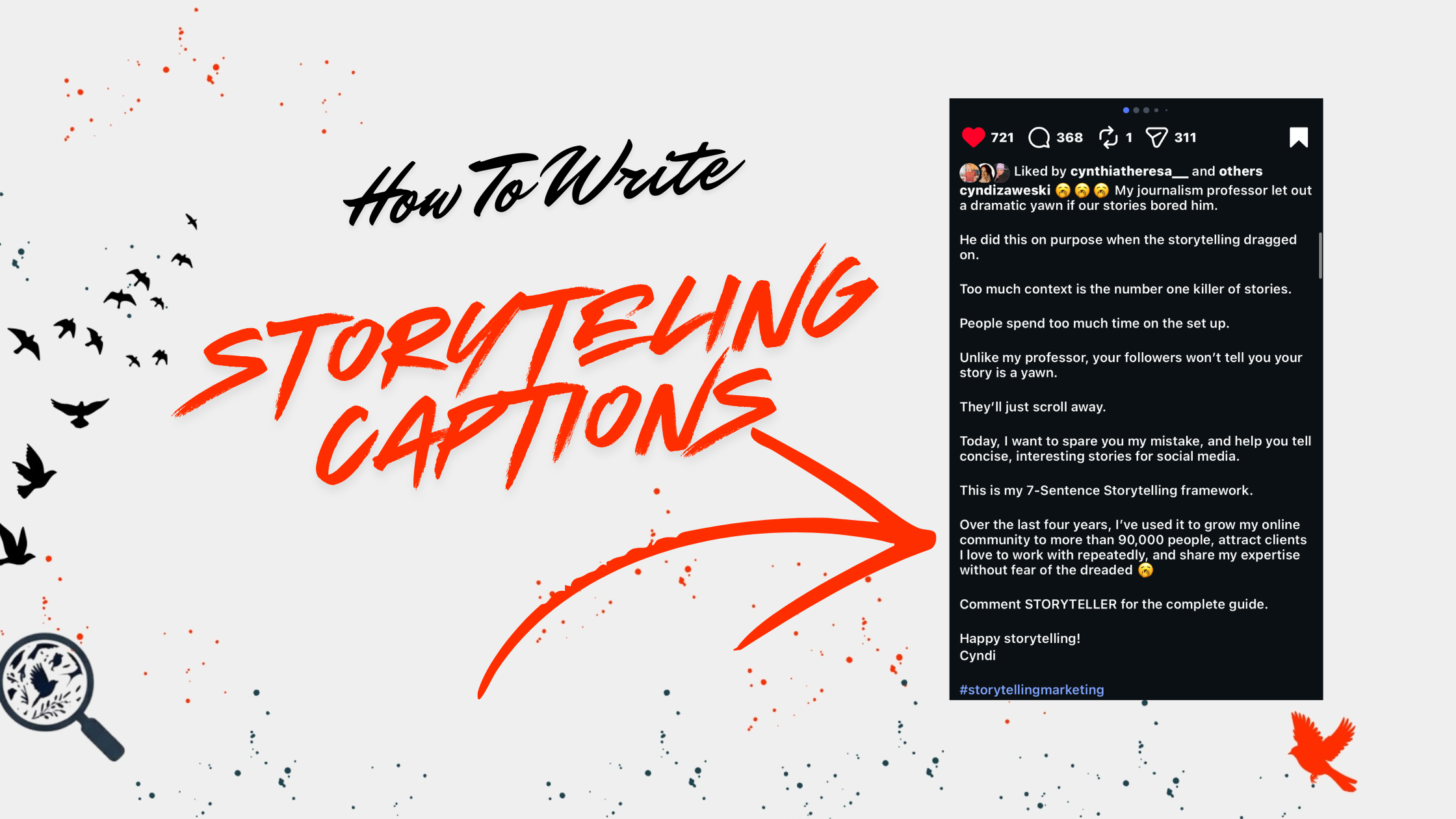
Writing storytelling captions for Instagram doesn’t require an MFA.
You don’t need to be a master of words.
You don’t need to be the most interesting person in your niche.
And you really don’t need to overshare the details of life in the name of being vulnerable and relatable.
Storytelling captions for Instagram come down to one thing: clear communication.
Effective short-form storytelling content does in 2,000 characters what most blog posts fail to do in 2,000 words: Make message easy to understand and emotionally engaging.
The mistake many entrepreneurs make with storytelling captions is trying to tell the whole story.
This mistake is twofold.
Because long-winded stories confuse people they also confuses the algorithm. In 2026, Instagram’s algorithm pushes out content people quickly grasp, send, save, or respond to. Shares and private sends have become especially important, and captions that make one meaningful point are more likely to be shared, saved, and acted upon than captions that ramble on.
That’s why micro storytelling is the secret to writing engaging captions that are people and algorithm approved.
A micro story captures one specific moment, realization, or conflict that lead a change in thinking, feeling, or behavior.
Micro stories are typically two to ten sentences and use a before and after narrative structure to illustrate change.
For example:
Not a micro story:
“I became a storyteller because I love helping people communicate.”
Micro-story:
“A client once told me, ‘I know what I do, but I don’t know how to explain why it matters.’ That sentence told me the real problem wasn’t content. It was clarity.”
In a business context, a good story helps your audience understand your point, perspective, process, or values.
That’s what’s happening in the second micro story example above. There was a specific moment — the client’s comment — that led to a realization and changed the way I understood the problem.
The most important goal of writing storytelling captions for Instagram is clarity, not dramatics.
And I promise, you can do this today in less than 15 minutes, even if you’ve never tried storytelling content creation before.
I’ll walk you through how write storytelling captions for Instagram that makes your point memorable and you’re audience interested in what you have to say.
What’s The Difference Between Storytelling Captions And Regular Captions?
The main difference between a storytelling caption for Instagram and a regular caption is immersiveness.
Regular captions provide facts about photo, video, or graphics their attached to.
Think: “New Product Drop!”
Storytelling captions, on the other hand, bring readers into what they’re seeing on the screen.
Like regular captions, they provide context and information.
But storytelling captions focus on transformation, a struggle, and sensory details that give lively dimension to the photo, video, or graphic contained to flat screen.
Think: "I almost didn't launch these sweaters. Three months ago, the factory sent the wrong yarn, and I spent an entire Tuesday crying on my kitchen floor over the ‘desert sand' I got vs. the '‘dusty rose' I wanted. But when I put the final product on, I realized the mistake was a blessing—it’s the perfect neutral metallic that pairs just as well with black dress pants as leggings—it’s hard to imagine a scenario I couldn’t wear it. Bask in its multi-functional glory with me by taking 25% in the shop.”
The regular caption gives the reader the update.
The storytelling caption gives them the experience.
The story caption packs in so many rich details: A new product announcement, how to style the product, and a sale—all in four sentences that are much more fun to read than “new product drop!”
How storytelling captions improve brand presence on Instagram
People naturally love to know the “why” behind things, and there is no more engaging way to explain why then through storytelling.
Yes, I am a storyteller and my brand is StoryCraft, so I am bias. But I am bias because it works. The data backs me up:
Platform heatmaps show that users spend 40% more time on posts that use first-person sensory language compared to "how-to" lists.
According to recent 2026 consumer reports, 72% of Gen Z and Millennial users say they intentionally skip AI-generated captions. They want the real story.
Posts with personal anecdote to a call-to-action (CTA) see a 3x higher click-through rate than posts that go straight to the pitch!
In short, storytelling captions improve brand presence on Instagram because they’re more engaging.
People are more likely to read your entire post, building trust in you and your offers in the process.
Micro storytelling also contributes to your larger brand narrative.

Spending time writing storytelling captions isn’t just a one-off win.
Every intentional storytelling caption you write is building a larger brand narrative that people remember long after you’ve posted.
These mini stories are what translate your big, high-level ideas into vibrant, bite-sized moments that people can connect with on a human level.
Building a brand narrative strategy doesn't have to be overwhelming.
It’s actually just a series of small, intentional choices in how you share your messages, values, and offers with the world.
Inspiration for personal brand storytelling captions
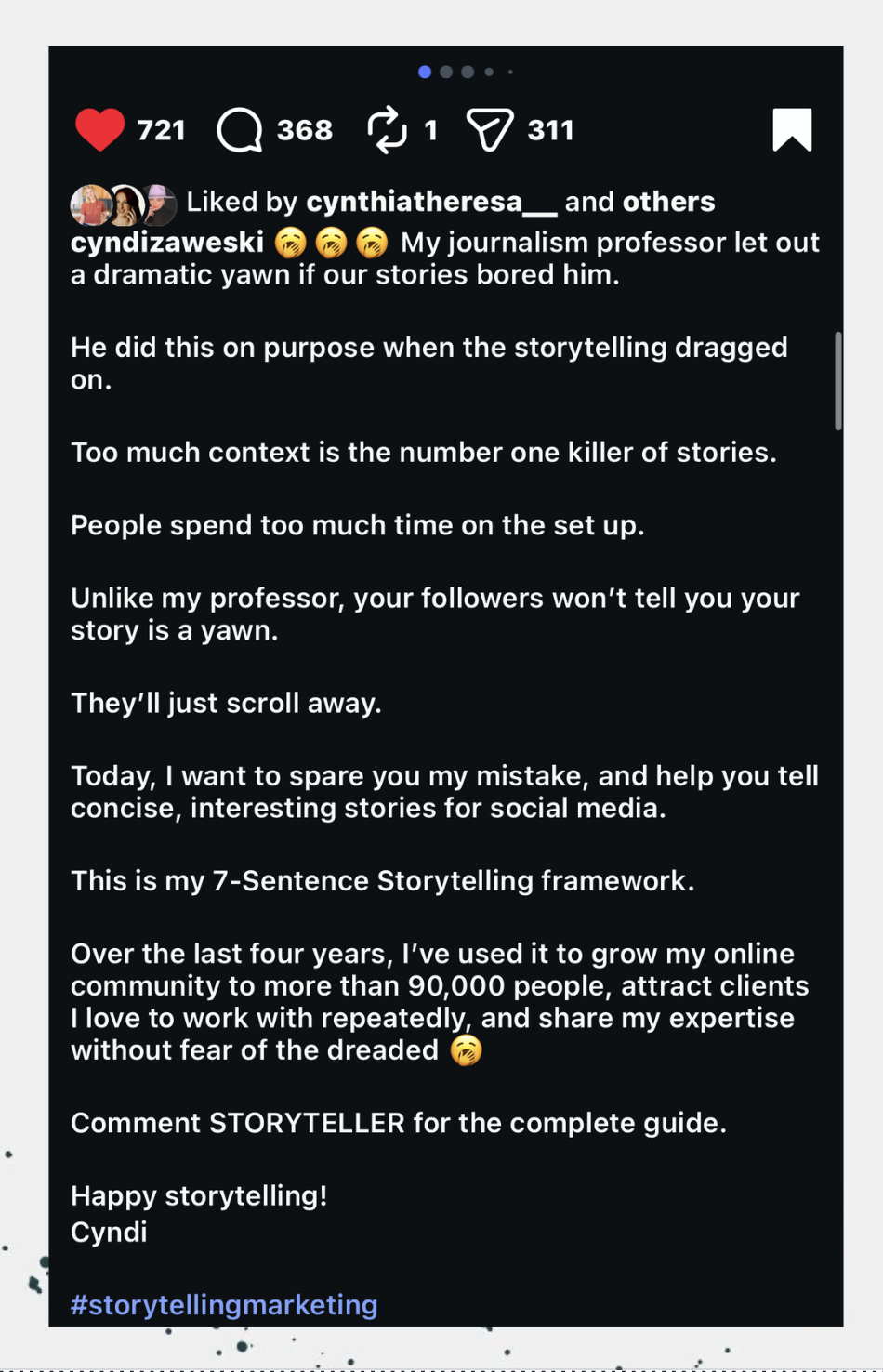
Looking for inspiration for personal brand storytelling captions?
Look no further than your brand messages. Here is an example of a storytelling caption for Instagram from my account that weaves in a brand message.
Let’s break it down:
A lot of what we teach as subject matter experts is abstract.
Terms like "conversion rates" or "heart-centered" don't actually mean anything to someone who hasn’t experienced it. If your audience has to work too hard to understand what your talking about or why it matters to them, they’ll just keep scrolling because decoding it takes too much mental energy. That’s why we use story to explain.
In my example caption, I didn’t want to say too much context is boring. Because if you’re not in the content world terms like “context” are abstract. I needed readers to get the importance of being concise, while acknowledging that it isn’t always easy and I had to learn the hard way.
This short storytelling caption gave context to the corresponding IG cover slide headline which said: “Master Storytelling in 7 Sentences.”
The slides gave them my viral 7 Sentence Storytelling Framework, and the caption told them why using the frameworks matters to them.
Stories create understanding, an understanding creates trust. So by the time they get to the end of your caption, they don’t just get the message—they believe it and you.
Ready to try this storytelling caption writing tip?
Grab my free Micro Storytelling Guide to write your own storytelling captions, Instagram carousels, and newsletters. (7 Sentence Storytelling Guide included.)
Tips for writing storytelling captions that boost Instagram engagement
Brevity is your friend when writing engaging storytelling caption for Instagram.
Not just because caption character counts are limited, but social media users aren’t there to read long, drawn out epics.
That’s why the hero’s journey and other traditional storytelling frameworks don’t translate well to short-form content marketing.
Good news: Length isn’t a requirement for engaging storytelling. You don’t have to write a lot to get your point across with these short-form storytelling techniques.
Here are a three tips for writing storytelling captions that boost Instagram engagement:
Focus on the emotional Transformation
Too much context is the number one killer of storytelling, especially online. You don’t need to include every detail or the entire sequence of events. You only need the details that help your audience understand the your point. Let’s say you want to write a storytelling for sales caption. The point is your offer gets results. The relevant detail is how your client feels after working with you. Here’s how this would work in real-life. Instead of recounting an entire client success story beginning from moment they booked a discovery call, dial into the moment they felt different because of your service. For example, “Last week, Suzie would rather have a root canal than look at a photo of herself. For years, she put off having brand photos taken because the pictures never looked quite like her. When we arrived on location, I could feel her holding her breath, waiting for the camera to confirm every insecurity she already had. So we didn’t start with the camera. We started with the atmosphere. We traded poses for presence. I watched her shoulders drop. They more she felt like herself, the more she looked like herself. Today, these photos are proof of what having a photographer who doesn’t just take photos really does.”
Use sensory details
Describing how the feeling manifests on a physical level is a cheat code for emotional storytelling in short-form content. Incorporating sensory details into your storytelling engages readers by drawing on all five sense: sight, sound, smell, taste, and touch. Senses translate into emotions because physical feelings—like a racing heart or a familiar scent—trigger an instinctive reaction in the reader's own body. Instead of just telling them what happened, you’re giving them the physical ingredients to feel the emotion for themselves. When you describe a sensation instead of naming an emotion, you let the reader's brain draw its own conclusion, which makes the experience your writing about play like movie in their mind they can’t turn away from. Here’s a deeper dive into the show don’t tell story technique.
What makes a good hook for an Instagram storytelling caption?
A good hook for an Instagram storytelling caption establishes the conflict immediately. Change is at the heart of every interesting story, and if you’ve ever tried to break a habit, shift your mindset, or update your website copy, you know there is no meaningful change without friction, resistance, or tension. Starting with conflict helps you avoid unnecessary context that buries the heart of your story. It also tells the reader what’s at stake right away, so they’re more compelled to keep reading to find out how it all gets resolved. The easiest way to write a story hook with conflict baked in is to use a combination of location and action to drop the reader straight into the problem: fighting the kitchen junk drawer to get it closed before the neighbor walks in, refreshing analytics under the covers as at midnight, or standing in front of an overstuffed closet, sighing in frustration, “I have nothing to wear.” The first line of every piece of content has the same job: to get people to read the next line. Conflict makes people want to keep reading.
Storytelling Caption Template For Instagram
Even if you’ve never written an Instagram caption that shares a brand story before, the process doesn’t have to take longer than 15-minutes.
I created this Micro Storytelling Guide so you can create more meaningfully in less time.
It includes inspiration for relevant brand story captions as well as my viral 7-Sentence Storytelling Template that shows you exactly to structure your story for the most impact.
But don’t limit yourself!
You can use this Micro Story Guide and framework for storytelling carousels, newsletters, and anywhere else you’d like to share short-form storytelling content.

Thanks for Reading!

Cyndi Zaweski, Owner of StoryCraft
Cyndi Zaweski is a former journalist and the owner of StoryCraft. She writes primarily about how narrative influences behavior, exploring how storytelling, belief, and perspective drive action through the lenses of marketing, philosophy, psychology, technology, and spirituality. Her advice for growing a newsletter without burning out is featured by Harvard’s Nieman StoryBoard. You can find her clients’ brand stories shared on major media outlets including iHeartRadio, CBC, and the Minimalist Podcast.
Storytelling Captions For Instagram FAQs
-
Use emojis in narrative captions the way you’d use punctuation.
A few good rules:
Use emojis to create structure.
Caption emojis should serve the flow of the story. They can break up sections or call attention to a turning point or call to action.Use them sparingly.
Less is more. Too many emojis can make a caption feel cluttered or spammy. Stick to 2-3 that are truly representative of the emotions you’re trying to convey.Avoid replacing words with emojis.
A narrative caption should still read clearly without them. Emojis should enhance the message, not become a message your audience has to decode. -
Storytelling captions improve brand presence on Instagram because they help your audience understand who you are, how you help, and why your work matters. A regular caption might share a tip, announce an offer, or describe what is happening in the post. A storytelling caption goes deeper by revealing the thinking, values, process, or point of view behind what people see on their screen. Trust is not built through visibility alone; it is built through consistent messaging. When the micro-stories you share in captions repeatedly reinforce your larger brand messages, your content begins to build a cohesive, memorable, and distinct brand narrative.
-
Inspiration for personal brand storytelling captions often comes from the small moments that reveal how you think, what you value, what you believe, and why your work matters. Instead of only looking for dramatic life stories, pay attention to the ordinary moments that point back to your larger brand messages: a client question you keep hearing, a mistake that changed how you work, a belief you had to unlearn, a behind-the-scenes decision, a conversation that clarified your message, or a moment when you realized your standards were different from everyone else’s. These moments work well because they help your audience understand the person behind the brand without requiring you to overshare.
-
Courses on mastering Instagram caption writing for storytelling can help you learn how to turn everyday moments, client experiences, personal insights, and brand messages into engaging short-form content. If you want to get better at writing storytelling captions for Instagram, look for a course that teaches more than hooks and content prompts. A strong storytelling course should help you understand how to find the message inside a story, structure a micro-story, create emotional tension, and connect each caption back to your larger brand narrative. Cyndi Zaweski’s Short-Form Storytelling Course teaches entrepreneurs and personal brands how to write clear, compelling storytelling captions, carousels, and newsletters that make their message memorable without oversharing or rambling.
