
How to Find Storytelling Content Ideas
Last Updated: April 2026
Storytelling Content Creation Is On The Rise
“Content marketing is the only marketing left” is a famous quote in my industry.
Marketing genius Seth Godin called it back in 2008 just as blogs and social media started to eclipse traditional advertising.
His bold statement was clear: Trade ads that talk at people for content marketing that talks to people—or be left to eat digital dust.
In the time it takes you to read this sentence 5,787 tweets, 1,099 Instagram posts, and 500 minutes of video to YouTube will be uploaded to the internet.
Nearly 20 years later, and it’s safe to say Godin was right. Content is king.
But the king is losing it’s crown.
Now that AI can spit out “How To” and “X ways to Y—without Pain Point” style posts in two seconds flat—the reign of content marketing is coming to a close.
Just four years after the release of ChatGPT, the numbers reflect the distrust and distaste our audiences are feeling.
In 2025, Instagram engagement dropped—again. This time by 26% as content fatigue hit an all-time high.
50% of Americans are now intentionally limiting social media to avoid attention-stealing content with no substance.
Nearly half of consumers (48%) now inherently distrust brands that rely on AI for their public-facing content.
As one era fades, another is coming into focus. But this time it’s not a trendy marketing tactic at all.
It’s a rediscovery and celebration of the most human form of communication: Storytelling.
In a world of infinite synthetic content, personal experience is premium.
Human-authored stories are currently seeing 40–60% longer session durations than AI-produced pieces because people crave the one thing AI will never have: A real life.
In 2008, Seth Godin was right —content was the only marketing left. But in 2026, story is the only content left.
Storytelling content creation is an AI-proof skill. Your ability to tell stories will set you apart now, and for the rest of your career.
Even if you’ve never told a story before, you’re not too late.
While most people are trying to figure out how to get AI write like them, you’ll be able to express your ideas through emotional storytelling content without relying on a robot to speak for you.
Let’s dive into three ways to find storytelling content ideas for your social media posts and newsletters that build trust and connection while making sales easier.
How to Find Storytelling Content Ideas
Coming up with relevant and relatable story ideas can be the hardest part about storytelling content creation.
Over the last six years in business as a brand storyteller, and decade-long career in journalism before that, if it’s one concern comes up time and again it’s the B word.
If I had a dime for every time I heard “my life boring,” I could have retired to Maui a long time ago.
The business owners who have hardest time coming up with marketing story ideas have one thing in common: They think every story needs to be a big, dramatic narrative for people to care.
That might be true around a dinner table with friends.
But the opposite is true in business storytelling. In business, "small" is actually better. You don't need to have survived a mountain lion attack to catch their attention. A story about a frustrating phone call or a morning where you felt completely unmotivated is often more interesting because it’s something your audience actually experiences and can relate to on an emotional level.
Being a great brand storyteller is all about knowing what micro stories to tell and when to tell them to communicate your brand message clearly.
It starts with knowing what to look for in a good story, and observing the story-worthy moments in your life.
What is a story-worthy moment?
A story-worthy moment is a small, seemingly ordinary, and often fleeting 5-second experience of realization or transformation that, when told, connects deeply with an audience. Popularized by award-winning storyteller Matthew Dicks, these moments don't need to be dramatic, but they must represent a change in thought, emotion, or self-perspective.
One of the best habits I’ve adopted to come up with endless story ideas from my everyday life takes five minutes a day.
In a simple Google spreadsheet, I jot down my story-worthy moment of the day.
Just two sentences:
What triggered the moment? What were you doing, thinking, feeling?
What happened as a consequence? What did you realize? How did your thoughts, behavior, or beliefs change?
That’s it. A simple before and after.
Change is the foundation of all stories, and when there’s an emotional shift and consequence as a result of that change, you know you have a good story.
I call this process my Two-Sentence Story Bank because the entries are, well, two sentences.
The goal is to leave yourself little notes that help you remember the moment and the lesson it shares.
Here’s an example of how I turn two-sentences from my story bank into a popular Instagram Carousel post:
1. Find Storytelling Content Ideas In Your Everyday Life

A secret to find story ideas to create relatable storytelling content is saying what others are thinking. This is a natural byproduct of slowing down and noticing what you notice, which will become second nature with your story bank practice.
This micro story example comes from a story-worthy moment at a local coffee shop last summer.
I learned the lesson,"When You Keep Showing Up People Notice. But You Have To Show Up For Yourself First," when a barista came over after five weeks of seeing me at the same table, doing the same work.
She told me my consistency was inspiring and gave me a coffee on the house.
This is a tiny moment that meant more than meets the eye—a clear sign it’s story-worthy.
Meaning is emotional.
When people sense the emotion in your message, they feel it too.
And stop to read it.
Perhaps like you, my community on Instagram is exhausted by the hustle culture of showing up for the algorithm.
This micro story moment pivoted that expectation—stating that the real power comes from showing up for yourself first. It wasn't just a clever hook. It was an unspoken truth that they felt in their bones but hadn't given themselves permission to voice.
All good storytelling is about articulating change, emotion, and meaning.
I mentally note the little moments that light me up and think about why they had an impact.
I question the cause behind that emotional shifts and reactionary behaviors in my day.
In this case, I realized the barista only noticed me because I had already spent five weeks showing up for myself before anyone else was watching. By noticing how my emotions and behavior shifted, I caught a deeper value in action: Sustainable productivity.
This is a mini narrative connects the dots between a two-sentence, story-worthy moment to a bigger brand message and value.
Here I opted to put the lesson as a bold headline on the first slide and the eight-sentence micro story about the barista on the second Carousel slide.
This tiny moment turned into a small story that reached more than 12,000 people in the first 24 hours, receiving more than 300 likes, 100 saves, and dozens of shares.
Storytelling Prompts To Find Mini-Narratives From Your Everyday Life
Interesting storytelling content ideas are all around you. Here’s a process for finding endless storytelling content ideas.
Observe: Notice what you notice. This can be a quote, a conversation with a client or friend, or something you saw on your favorite HGTV show.
Reflect: Find the universal truth in the small moment. Why was that observation so meaningful that it stuck out in your brain?
Connect: Tie the observation and its bigger meaning to your brand message or value. What is the new realization you want your audience to walk away with?
Upon deeper reflection and connection to a bigger message or value, the micro moments you observe from your everyday could be your audience’s next favorite post.
2. Find Other People’s Stories To Share Your Brand Message

If you’re an introverted entrepreneur or you’re just not ready to share your story yet, you can still create storytelling content.
Using other people’s story to share your brand message is an underrated way to use storytelling in content creation because they’re both interesting and relevant—if you can connect the dots. I discovered this nugget about Jobs when I was reading a book. Again, I stored this gem in my story bank weeks before turning it into storytelling content.
Things you hear on a podcast, read in a book, or spot while scrolling make for great micro story ideas —as long as you put your twist on the idea.
I turned this story idea into viral storytelling content by using my Seven Sentence Storytelling Framework to write a micro story that shared my brand message.
It starts with a counterintuitive truth captured in a hold Instagram headline that hits like a cognitive speed bump. It forces the reader to physically slow down and reconsider what they thought they knew. Because the world has canonized Jobs as the ultimate communicator, a headline like that blows expectations out of the water. It creates a gravitational force of uncertainty, pulling people in because they have to know how that could possibly be true.
This storytelling Carousel goes on to solidify my brand message by sharing a micro narrative about Jobs’ journey from terrible storyteller to earning storytelling God status.
Did you know that before Job’s legendary "1,000 songs in your pocket" era, there was the LISA era— with a nine-page, jargon-filled New York Times ad that flopped so hard it essentially got him fired from his own company?
By showing that even the "God of Storytelling" had to fail first, I shared my brand message: You don’t have to be a natural born storyteller to tell great stories.
And I gave my readers the warmest feeling of all: Hope. I met them in their frustration ("I’m just not a natural storyteller") and led them to empowerment ("I can learn this, too").
You can read the full “Steve Jobs Sucked at Storytelling” Carousel here. You’ll see how I broke down the narrative into bite size chunks with one-to-two sentences on each slide.
If you want to try it for yourself, here’s my free Seven Sentence Storytelling Framework.
Storytelling Prompts To Share Brand Messages In Content
How do you find other people’s stories that illustrate your brand message?
ChatGPT can help you out here.
Type in your brand message and request famous examples that illustrate your point.
But remember the data from the intro: Publishing AI content written content can cause irreparable damage to your brand reputation.
Once you have the idea, use the Seven Sentence Storytelling Framework to write the story so it’s your point of view, in your brand voice.
3. Find Storytelling Content Ideas For Sales
Most marketing advice tells you that if you want to sell, you have to twist the knife. The theory is that if you poke at a person's pain points until they feel broken enough, they’ll buy anything.
I’m a firm believer that twisting the knife is 100% unethical—and 1000% unnecessary.
In fact, 168 days ago I decided to give my business a break from social media.
My marketing without social media plan includes reworking my email automations, search-optimized blogs, and creating evergreen Pinterest Pins to do the selling for me by peppering in stories.
But not just any sales stories.
I use the Common Enemy narrative technique from my Short-form Storytelling Course—and my sales are up 176%.
Here’s how you can apply this narrative strategy to find storytelling content ideas for sales.
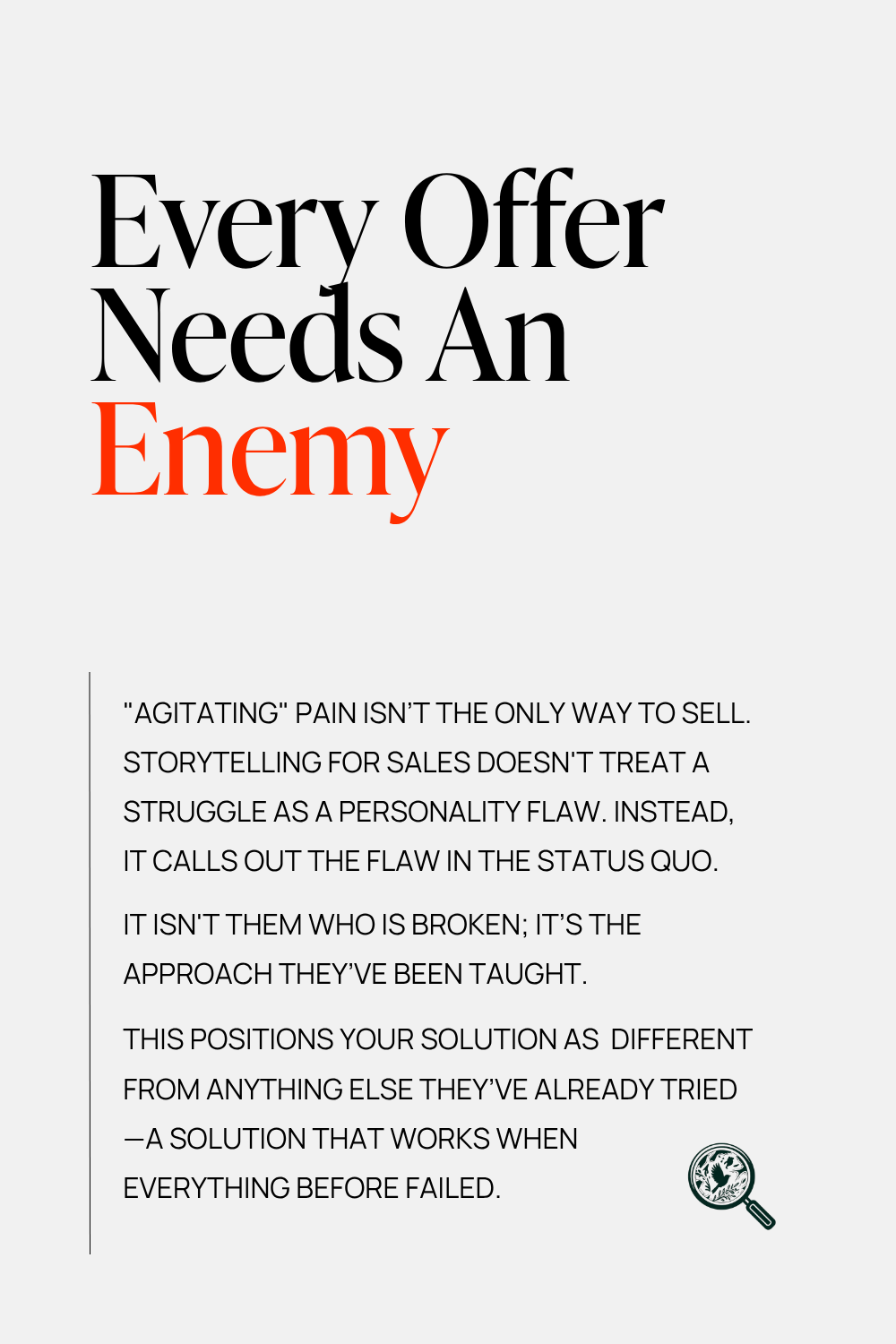
Marketing doesn’t need to make people feel bad to work. In fact, sales messages that empower people are the ones that empower people to act.
They make a reader more likely not just to buy, but to follow through and get results.
Instead of making the customer’s problem a personal failing, we use this storytelling for sales method to rally them against the status quo.
Unlike traditional tactics, this type of storytelling doesn’t make people feel less than for having a problem.
It makes the customer the hero by calling out a root cause that isn't their fault. You aren't blaming their personality; you’re blaming a flaw in the "normal," popular, or trendy way of doing things.
Storytelling For Sales Idea Example
Imagine you’re a health coach. Your potential clients are frustrated because they’ve tried every diet and "failed" again.
Instead of telling them they need more willpower, you get on their side.You tell stories about how the diet industry is actually designed to keep them on a cycle of restriction.
You share stories about how food dyes impact metabolism or how predatory marketing relies on their low self-esteem to sell a product that was never meant to work.
By identifying the enemy (the status quo, in this case), you provide context for their struggle, giving them hope that a new way (your way) could work for them.
Story Prompts For Sales Content Creation
Research the Status Quo: What are the accepted truths in your industry that don’t work for your people? (AI can be a great research assistant here for finding data, provided you fact-check).
Share Your Personal Experience: Pepper in your own experiences—or your clients' experiences—with that enemy. What did it feel like to follow the rules and still lose?
Make Your Offer Clear With Juxtaposition: Clearly show why your method is the true alternative. How does your way specifically circumvent the flaws of the status quo?
These story prompts aren’t the only ways to come up with storytelling content ideas for business, but they are among the ones I used the most to grow my online community to more than 80,000 people and build a six-figure business working from home (mostly in my PJs). If you want to become a story telling content creator, these prompts will get you started ASAP.
Turn Your Storytelling Content Ideas Into Storytelling Content
Once upon a time, Seth Godin was right—content marketing was the only marketing left.
But today, storytelling content is the only content left— at least for us humans who want to communicate intentionally and connect emotionally while making our brand messages heard loud and clear.
Coming up with marketing story ideas might be the hardest part of the process, but sitting down to write it can have you second-guessing how to turn your idea into a post.
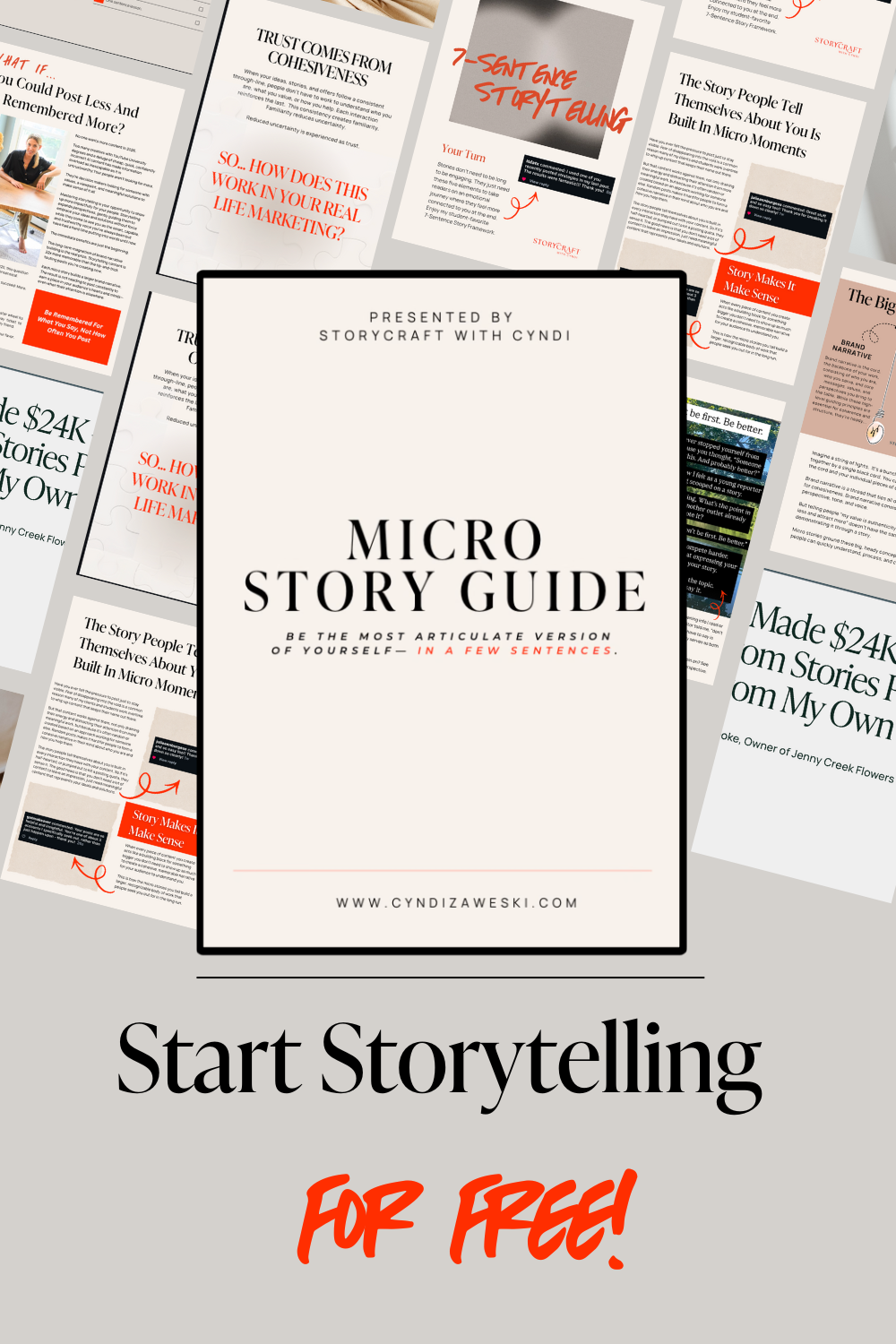
That’s why I put together this free Micro-Storytelling Guide so you can implement these storytelling content ideas in your short-form content.
In as little as 15 minutes you can go from “I sorta have a story idea” to hitting publish on an emotionally-relevant post makes your brand message memorable and trustworthy.
In this free guide, you’ll get:
The three types of emotionally-relevant micro stories
My viral 7-Sentence Storytelling Framework For Social Media
How to tell stories that feel like you — and take only a few minutes to write
Cherry On Top: you can log off with the peace of mind that you won’t be forgotten, because storytelling is 22x more memorable than regular posting.
Thanks For Reading!

Cyndi Zaweski, Owner of StoryCraft
Cyndi Zaweski is an independent journalist and the owner of StoryCraft. She writes primarily about how narrative influences behavior, exploring how storytelling, belief, and perspective drive action through the lenses of marketing, philosophy, psychology, technology, spirituality, and beyond. Her brand story clients have been featured on CBC, iHeartRadio, The Minimalist Podcast, and more.
